
Superposition & Interference
Drop two stones in a still pond and watch the ripples pass clean through each other — yet for one shimmering instant, they add up into something new.
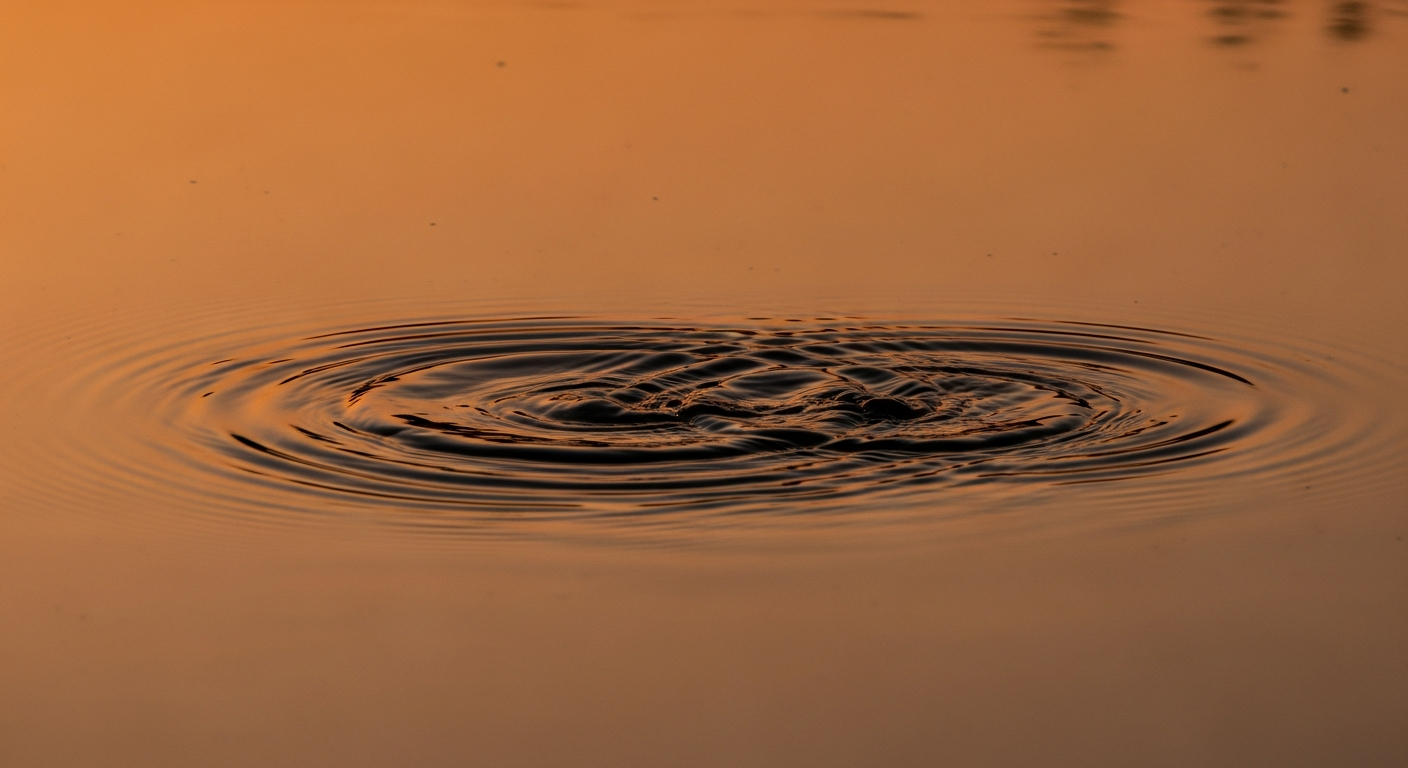
Two Ripples Meet
Toss two stones into a still pond a few feet apart. Each one sends out a circle of ripples, and where those circles cross, something interesting happens: for an instant the water rises higher than either ripple alone would make it, or barely moves at all — and then both ripples keep spreading outward, completely unbothered, as if the crossing never happened.
That's the single strangest and most useful fact about waves: unlike two marbles, two waves can occupy the same point in space at the same time. What you see there is neither wave alone — it's both, added together.
When two or more waves overlap at a point, the resulting displacement is the algebraic sum of the displacements each wave would have produced on its own. Crests (positive) and troughs (negative) simply add with their signs. Once the waves pass each other, each continues on exactly as it would have if it had traveled alone — the overlap changes nothing permanent.
Why Path Difference Is the Whole Story
Call the distance from source A to some point d₁, and the distance from source B to that same point d₂. The path difference is \( \Delta = |d_1 - d_2| \) — literally, how much extra distance one wave had to travel to reach that point.
That extra distance is what determines whether the two waves arrive in step or out of step. If Δ happens to be a whole number of wavelengths, both waves have completed a whole number of extra cycles, so they arrive crest-to-crest: constructive interference. If Δ is a whole number of wavelengths plus half, one wave arrives exactly upside-down relative to the other: destructive interference.
- Apply the superposition principle: add the individual displacements algebraically.
- (a) Both pulses are positive (same side): \( y_{\text{total}} = +4\text{ cm} + 3\text{ cm} = +7\text{ cm} \). This is constructive — the pulses reinforce.
- (b) One pulse is now negative: \( y_{\text{total}} = +4\text{ cm} + (-3\text{ cm}) = +1\text{ cm} \). The pulses partially cancel, but because their amplitudes aren't equal, they don't fully cancel to zero.
- Find the wavelength: \( \lambda = \dfrac{v}{f} = \dfrac{340\text{ m/s}}{850\text{ Hz}} = 0.400\text{ m} \).
- Find the path difference: \( \Delta = |d_1 - d_2| = |8.00\text{ m} - 6.80\text{ m}| = 1.20\text{ m} \).
- Express Δ in wavelengths: \( \dfrac{\Delta}{\lambda} = \dfrac{1.20}{0.400} = 3.00 \), a whole number.
- Since \( \Delta = 3\lambda \) (n = 3, an integer), the condition for constructive interference is satisfied.
Destructive interference doesn't destroy energy. Where two waves cancel, the energy doesn't vanish — it shows up as extra amplitude somewhere else in the pattern. Superposition redistributes energy; it never deletes it.
The Δ = nλ rule assumes the sources start in phase. If the two sources are already out of step with each other, you have to fold that starting offset into the condition. And none of this produces a stable pattern unless the sources are coherent — same frequency, with a phase relationship that stays fixed over time. Two ordinary light bulbs flicker in and out of step so fast that any interference pattern they make is smeared into invisibility; a laser split into two beams (or two speakers driven by the same signal) stays coherent, which is why the pattern holds still long enough to see or hear.
Check your understanding
- Superposition: where two waves overlap, the total displacement is just the algebraic sum of each wave's displacement — and each wave carries on afterward as if the other were never there.
- Constructive interference (louder sound, brighter light) occurs when the path difference between two in-phase sources is a whole number of wavelengths: Δ = nλ.
- Destructive interference (quiet, dark) occurs when the path difference is a half-integer number of wavelengths: Δ = (n + 1/2)λ.
- A steady, observable interference pattern needs coherent sources — same frequency and a phase relationship that doesn't drift over time.
🎓 Go deeper: external courses & trusted references
External sites are listed for reference only. This course is independent and has no affiliation with, or endorsement from, the institutions named.