
Standing Waves & Resonance
Two waves collide head-on and, instead of chaos, you get a pattern that just sits there and pulses — that stillness is the whole trick.
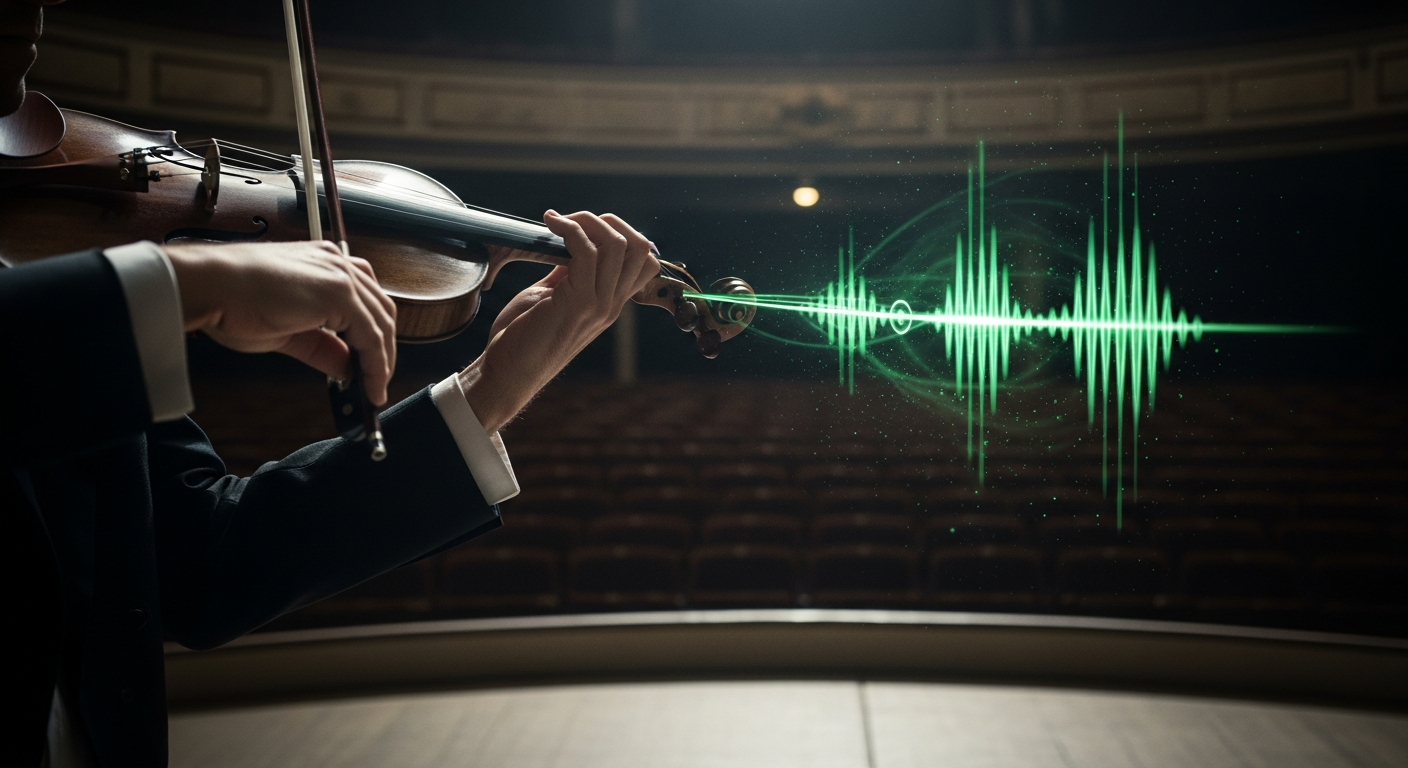
Two waves, one still pattern
Pluck a guitar string and send a wave pulse down its length. It hits the fixed end, flips over, and travels straight back toward you. Now you've got two waves — the one you sent and its reflection — moving through the exact same string in opposite directions at the same time.
Most of the time, overlapping waves make a messy, shifting jumble. But if the timing lines up just right, something strange happens: the jumble locks into a fixed shape. Certain points never move at all. Other points swing back and forth with the biggest amplitude the string ever shows. Nothing in the pattern appears to travel left or right anymore — it just pulses in place. That's a standing wave.
A node is a point that stays motionless the entire time — at that exact spot, the crest of the rightward wave always arrives at the same instant as the trough of the leftward wave, so they cancel completely, forever. An antinode is a point where the two waves' crests (and later, troughs) always arrive together, adding up to double amplitude.
Adjacent nodes are always spaced half a wavelength apart, and an antinode sits exactly halfway between each pair of nodes. A string fixed at both ends must have a node at each end — the string can't move where it's clamped — and that one geometric fact is what restricts which wavelengths are allowed to fit.
Resonance: pushing at exactly the right rhythm
Every physical string, air column, or bridge has its own set of natural (harmonic) frequencies, set entirely by its length and wave speed. If you drive the system with a periodic push — a bow, a speaker, a gust of wind — at a frequency that doesn't match any harmonic, the energy you put in mostly cancels itself out and the response stays small.
But if you drive it at (or very near) one of those harmonic frequencies, each new push arrives in step with the motion already there, and the energy keeps adding up. The amplitude grows dramatically even though each individual push is small. That's resonance — it's why singers can shatter glasses, why marching soldiers break step crossing a bridge, and why a swing goes higher when you pump it at the right moments rather than randomly.
- Use \(\lambda_n = 2L/n\) with \(L = 2.0\text{ m}\).
- n = 1 (fundamental): \(\lambda_1 = 2(2.0)/1 = 4.0\text{ m}\), so \(f_1 = v/\lambda_1 = 40/4.0 = 10\text{ Hz}\).
- n = 2 (2nd harmonic): \(\lambda_2 = 2(2.0)/2 = 2.0\text{ m}\), so \(f_2 = 40/2.0 = 20\text{ Hz}\).
- n = 3 (3rd harmonic): \(\lambda_3 = 2(2.0)/3 \approx 1.33\text{ m}\), so \(f_3 = 40/1.33 \approx 30\text{ Hz}\).
- Notice each harmonic frequency is just n times the fundamental: 10, 20, 30 Hz — that pattern always holds.
- The fundamental corresponds to n = 1, where \(\lambda_1 = 2L = 2(0.65) = 1.3\text{ m}\).
- Use \(v = f\lambda\): \(v = (110\text{ Hz})(1.3\text{ m})\).
- \(v = 143\text{ m/s}\).
It's tempting to think the n-th harmonic pattern shows n full wavelengths on the string — it doesn't. It shows n half-wavelengths (n antinodes, n+1 nodes counting both ends). That's exactly why \(\lambda_n = 2L/n\) has that factor of 2: a full wavelength needs a full crest-to-crest cycle, but each 'loop' you see between two nodes is only half of one.
Also remember this specific formula assumes both ends are fixed (nodes at both ends), like a guitar or violin string. A tube open at one end, or a string free at one end, has a different pattern — node at the fixed end, antinode at the free end — and a different formula.
Check your understanding
- A standing wave forms when two identical waves travel in opposite directions through the same medium, typically from a wave reflecting off a fixed boundary.
- Nodes (always still) and antinodes (maximum swing) alternate along the pattern, spaced half a wavelength apart.
- A string fixed at both ends only allows wavelengths given by \(\lambda_n = 2L/n\), producing harmonic frequencies \(f_n = nv/2L\) that are whole-number multiples of the fundamental.
- Resonance is what happens when a driving force matches one of these natural harmonic frequencies, letting small pushes build into large amplitude.
🎓 Go deeper: external courses & trusted references
External sites are listed for reference only. This course is independent and has no affiliation with, or endorsement from, the institutions named.