
Sound & Acoustics
Every voice, drumbeat, and clap of thunder is just air molecules jostling their neighbors in a chain reaction of push and pull.
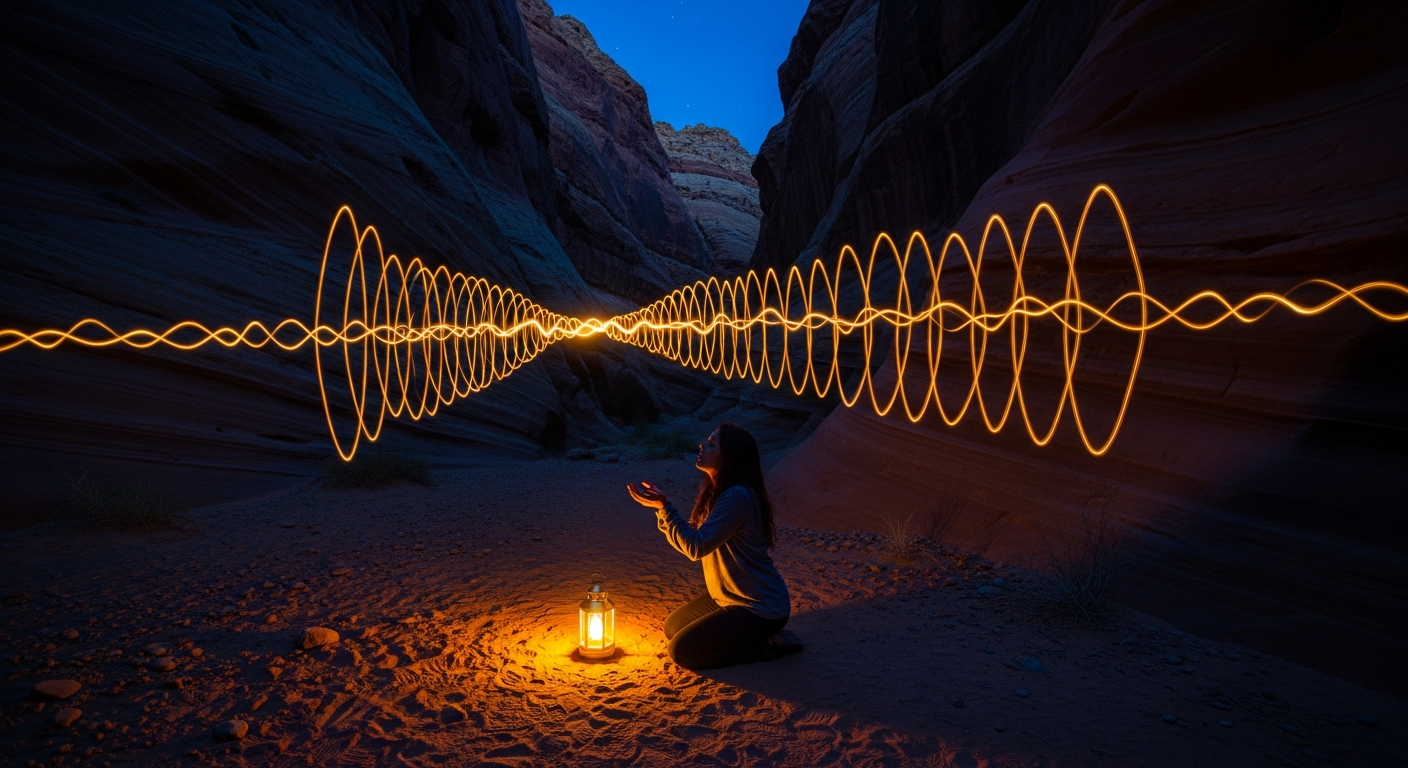
The Wave You Can't See
Clap your hands right now. What just happened, physically? Your palms slammed together and shoved the air molecules between them outward. Those molecules crashed into their neighbors, which crashed into theirs, and so on — a ripple of "bunched-up" air raced outward in every direction until it jiggled the eardrums in your head. That jiggle is all a sound wave is: energy passed from molecule to molecule, with no single molecule traveling far at all.
Because sound needs molecules to shove, it needs a medium — air, water, wood, steel, anything with particles close enough to bump into each other. That's why there's no sound in the vacuum of space, no matter what the movies show.
In a longitudinal wave, the medium moves back and forth along the same line the wave travels, creating alternating regions of compression (molecules squeezed close) and rarefaction (molecules spread apart). Two properties of that wave map directly onto what you hear:
- Pitch ↔ frequency — more compressions per second sounds higher.
- Loudness ↔ amplitude — bigger compressions (more energy) sound louder.
A healthy young human ear typically picks up frequencies from about 20 Hz (a deep rumble) to 20,000 Hz (a shrill, almost painful hiss) — that range is called the audible range, and it shrinks a bit with age.
- Start with v = fλ and rearrange to solve for wavelength: λ = v / f.
- Plug in the numbers: λ = 343 m/s ÷ 440 Hz.
- λ = 0.7795 m, which rounds to about 0.78 m — a little under 80 cm.
Echoes and Resonance: Sound Meeting Itself
An echo is just a reflection: sound bounces off a hard, distant surface and comes back to your ear a little later. Because you now know the speed of sound, a stopwatch and a cliff face are all you need to measure distance — which is exactly how early scientists first pinned down how fast sound actually travels.
Resonance is a different but related idea: every object has a natural frequency it "likes" to vibrate at, set by its size, shape, and stiffness. Drive it with a periodic push at exactly that frequency — a singer's sustained note driving a wine glass, a child's swing pushed in rhythm with its own back-and-forth, an engine part vibrating at a troublesome RPM — and the vibrations build up on each other, growing far larger than a single gentle push should allow. That's why the right note (not just a loud one) is what can crack a wine glass: it's frequency-matching, not raw volume, that makes resonance work.
- The 1.00 s covers the sound's full round trip: out to the cliff AND back to you.
- Total distance traveled = speed × time = 343 m/s × 1.00 s = 343 m.
- That 343 m is there-and-back, so the one-way distance to the cliff is 343 m ÷ 2 = 171.5 m.
- Pitch ≠ loudness. A whisper and a shout can be the exact same pitch (frequency) while differing hugely in loudness (amplitude) — they're independent dials.
- No medium, no sound. Sound cannot travel through a vacuum — space really is silent, whatever the sci-fi soundtrack says.
- Decibels aren't a simple ruler. The decibel scale for loudness is logarithmic, so a jump of +10 dB means roughly ten times more sound energy, not just "a bit louder."
- Resonance needs the right frequency, not just volume. Driving an object with sound (or any periodic push) doesn't cause resonance unless the driving frequency matches its natural frequency.
Check your understanding
- Sound is a longitudinal mechanical wave: molecules compress and spread out along the direction of travel, and it needs a medium — no sound in a vacuum.
- Pitch is what your ear hears from frequency; loudness is what it hears from amplitude — they're independent properties.
- Wave speed, frequency, and wavelength are linked by v = fλ, and the speed of sound in air rises with temperature (≈343 m/s at 20°C).
- Echoes are reflected sound you can time to measure distance, while resonance happens when a periodic push matches an object's own natural frequency, building up large vibrations.
🎓 Go deeper: external courses & trusted references
External sites are listed for reference only. This course is independent and has no affiliation with, or endorsement from, the institutions named.