
Physics 🔦 Optics & Light

Mirrors & Curved Reflectors

Why a flat mirror shows you exactly as you are, but a curved one can turn you upside down, huge, or tiny — all from the same law of reflection.
High schoolAP Physics 2 level
💡
The big idea: Every mirror obeys the same law of reflection at every point on its surface — curving that surface just changes which direction each point redirects light. That one geometric fact is enough to predict, with a single equation, exactly where an image will form, whether it's real or virtual, and how big it will be.
🎯 By the end, you'll be able to
  • Explain why plane mirrors always produce upright, same-size virtual images located exactly as far behind the mirror as the object is in front.
  • Apply the mirror equation and its sign convention to find where an image forms for both concave and convex mirrors.
  • Predict whether an image will be real or virtual, upright or inverted, and magnified or reduced, just from knowing where the object sits relative to the focal point.
  • Calculate magnification with m = −di/do and correctly interpret the meaning of its sign and size.
📎 You should already know
  • Law of reflection (angle of incidence = angle of reflection)
  • Comfort with algebraic fractions
  • Basic ray-diagram thinking for lenses/mirrors

The Mirror That Bends the Rules

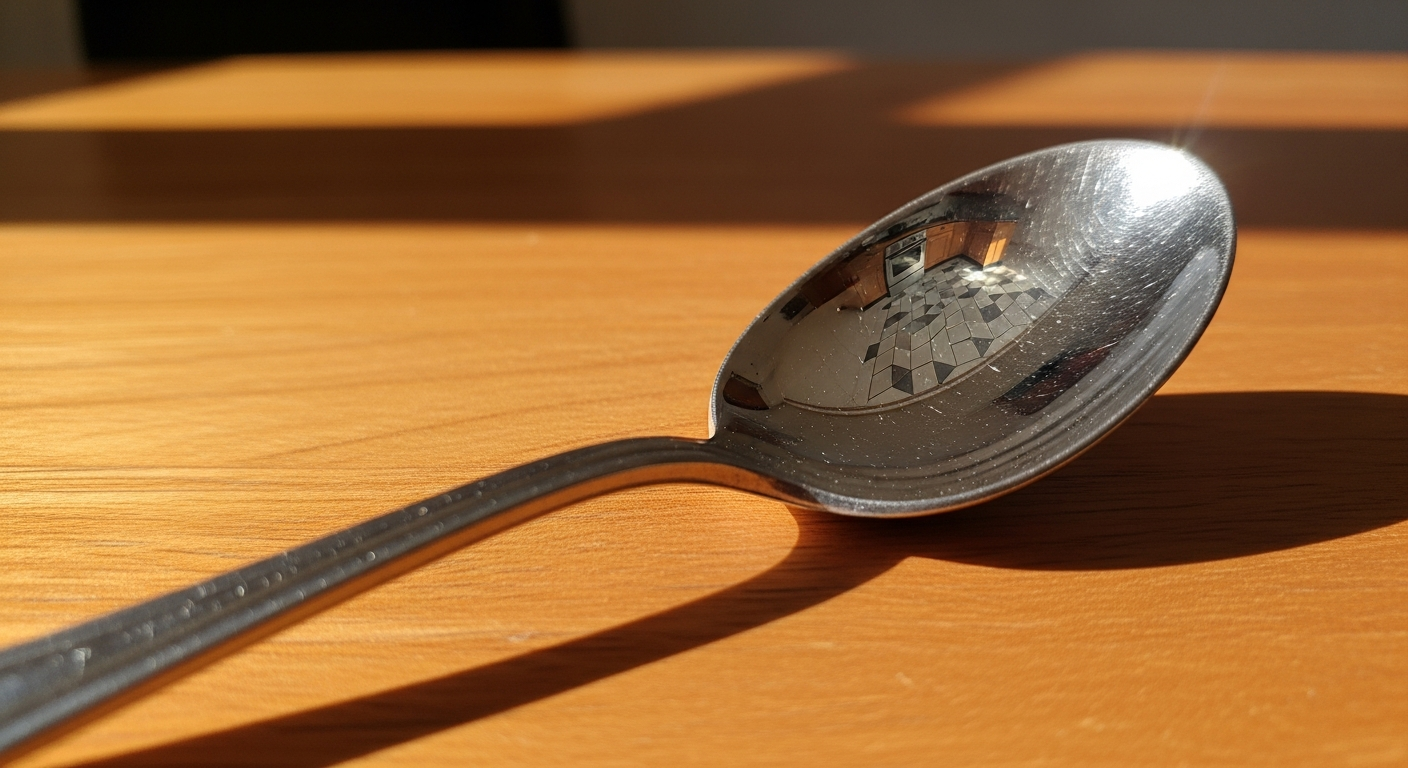
Look into a flat mirror and the world looks back exactly as it is — same size, right where you'd expect. Now look into the back of a shiny spoon. Suddenly your face is upside down, tiny, and floating in space. Same law of reflection both times, wildly different result. The secret is curvature: a curved mirror doesn't just flip light, it focuses it, and that single geometric fact explains everything from makeup mirrors to car mirrors to reflecting telescopes.

🔑 The one idea that runs the whole chapter

Every mirror — flat or curved — obeys the same law of reflection at every single point on its surface. Curving the surface just changes the local angle that law is applied at, point to point, so reflected rays that used to stay parallel now either converge toward a real point (concave) or spread apart as if streaming from a point behind the glass (convex). Curvature steers where reflected rays go — that's the whole story.

\[ f = \frac{R}{2} \]
A mirror's focal length is half its radius of curvature — a gentler curve (large R) gives a longer focal length; a sharper curve gives a shorter one. (This holds for paraxial rays — those close to the central axis; sharply curved mirrors show some blurring for rays far from the axis, an effect called spherical aberration.)
\[ \frac{1}{f} = \frac{1}{d_o} + \frac{1}{d_i} \]
f = focal length, dₒ = object distance from the mirror, dᵢ = image distance from the mirror, all measured along the mirror's central axis.
\[ m = -\frac{d_i}{d_o} \]
Magnification compares image height to object height: |m|>1 is bigger, |m|<1 is smaller, and a negative sign means the image is flipped upside down.

Reading the signs correctly

Sign convention is where most confusion lives, so let's nail it down. For a concave mirror, f is positive — light really converges at a real focal point in front of the mirror. For a convex mirror, f is negative — light only appears to come from a point behind the mirror; nothing physically reaches it. Once you solve for \(d_i\): positive means a real image in front of the mirror, negative means a virtual image behind it.

🎮 Interactive: Drag the Object and Watch the Image Form LIVE
Slide the object closer to and farther from a concave or convex mirror and watch where the image lands, whether it flips, and how its size changes as it crosses the focal point.
📝 Worked example: A concave mirror has a focal length of 20 cm. An object is placed 30 cm in front of it. Where does the image form, and how is it oriented?
  1. Mirror equation: 1/f = 1/do + 1/di → 1/di = 1/f − 1/do.
  2. Plug in: 1/di = 1/20 − 1/30 = 3/60 − 2/60 = 1/60.
  3. So di = 60 cm. Positive means the image is real, forming 60 cm in front of the mirror.
  4. Magnification: m = −di/do = −60/30 = −2.
✓ The image forms 60 cm in front of the mirror: real, inverted, and twice the object's height. This is the kind of real, projectable image a reflecting telescope or a floodlight's collecting mirror relies on.
📝 Worked example: A convex mirror (like a blind-spot mirror) has a focal length of magnitude 20 cm, so f = −20 cm in the sign convention. An object sits 20 cm in front of it. Find the image location and magnification.
  1. 1/di = 1/f − 1/do = 1/(−20) − 1/20 = −1/20 − 1/20 = −2/20 = −1/10.
  2. di = −10 cm. The negative sign means the image is virtual, sitting 10 cm behind the mirror's surface.
  3. m = −di/do = −(−10)/20 = 0.5.
✓ The image is virtual, upright, and half the object's height, sitting 10 cm behind the mirror — exactly why convex mirrors always show a smaller, upright world: that shrinkage is what buys the wider field of view.
✨ Why makeup mirrors magnify but car mirrors shrink

Put an object inside a concave mirror's focal point (do < f) and the reflected rays diverge after leaving the mirror instead of converging — so instead of meeting at a real point, they only appear to spread from a point behind the mirror, forming a virtual image, just as with a convex mirror. But the resemblance stops there: because the concave surface curves toward the object rather than away from it, that virtual image comes out magnified rather than reduced. That's exactly how a concave shaving or makeup mirror works: get close enough — inside the focal length — and you get a big, upright, virtual version of your face. A convex mirror, by contrast, always diverges light no matter the object distance, so it always gives a virtual, upright, reduced image — perfect for wide-angle views like side mirrors and security domes.

⚠️ Don't trust your eye for 'behind the mirror'

A negative image distance doesn't mean light travels backward through the glass — no light ever reaches that point. It means your brain is tracing the diverging reflected rays backward in straight lines and perceiving a virtual image there, just as a flat mirror's image seems to sit behind the glass. Also remember: object distance \(d_o\) is essentially always positive, so all the sign action happens in \(f\) and \(d_i\). Mixing up which one is negative is the single most common mistake in this topic.

Check your understanding

1. What kind of image does a flat (plane) mirror always produce?
A plane mirror is the zero-curvature special case: no convergence or divergence, so the image is always virtual (behind the glass), upright, and exactly the object's size.
2. A concave mirror has a focal length of 10 cm. An object sits 15 cm in front of it. How far from the mirror does the image form?
1/di = 1/f − 1/do = 1/10 − 1/15 = 3/30 − 2/30 = 1/30, so di = 30 cm. The positive value means a real image forms 30 cm in front of the mirror.
3. A convex security mirror shows you smaller than a flat mirror would, but lets you see a much wider area of the room. Why?
Because every point on a convex surface curves away from the center, reflected rays spread out rather than converge. Tracing those diverging rays backward puts a shrunk, virtual image close behind the mirror — which is exactly what lets a wide swath of the room compress into one small image.
4. An object is placed inside the focal point of a concave mirror (do < f), like in a shaving or makeup mirror. What kind of image forms?
When do < f, 1/do > 1/f, so 1/di = 1/f − 1/do comes out negative — di is negative, meaning a virtual image behind the mirror. The magnification m = −di/do then comes out positive and greater than 1: upright and enlarged. That's exactly how a magnifying shaving mirror works.
✅ Key takeaways
  • Plane mirrors reflect a virtual, upright, same-size image the same distance behind the mirror as the object is in front of it.
  • Curved mirrors have a focal length f = R/2; concave mirrors converge light to a real focal point in front, while convex mirrors diverge light from a virtual focal point behind the glass.
  • The mirror equation 1/f = 1/do + 1/di and magnification m = −di/do let you calculate exactly where an image forms, whether it's real or virtual, and how big it is.
  • A negative di or positive/negative m tells the whole story: negative di means virtual (behind the mirror); negative m means inverted; positive m means upright.