
Lenses & Image Formation
Curved glass bends light in predictable ways — learn to trace the rays and you can predict exactly where any image will appear, real or imagined.
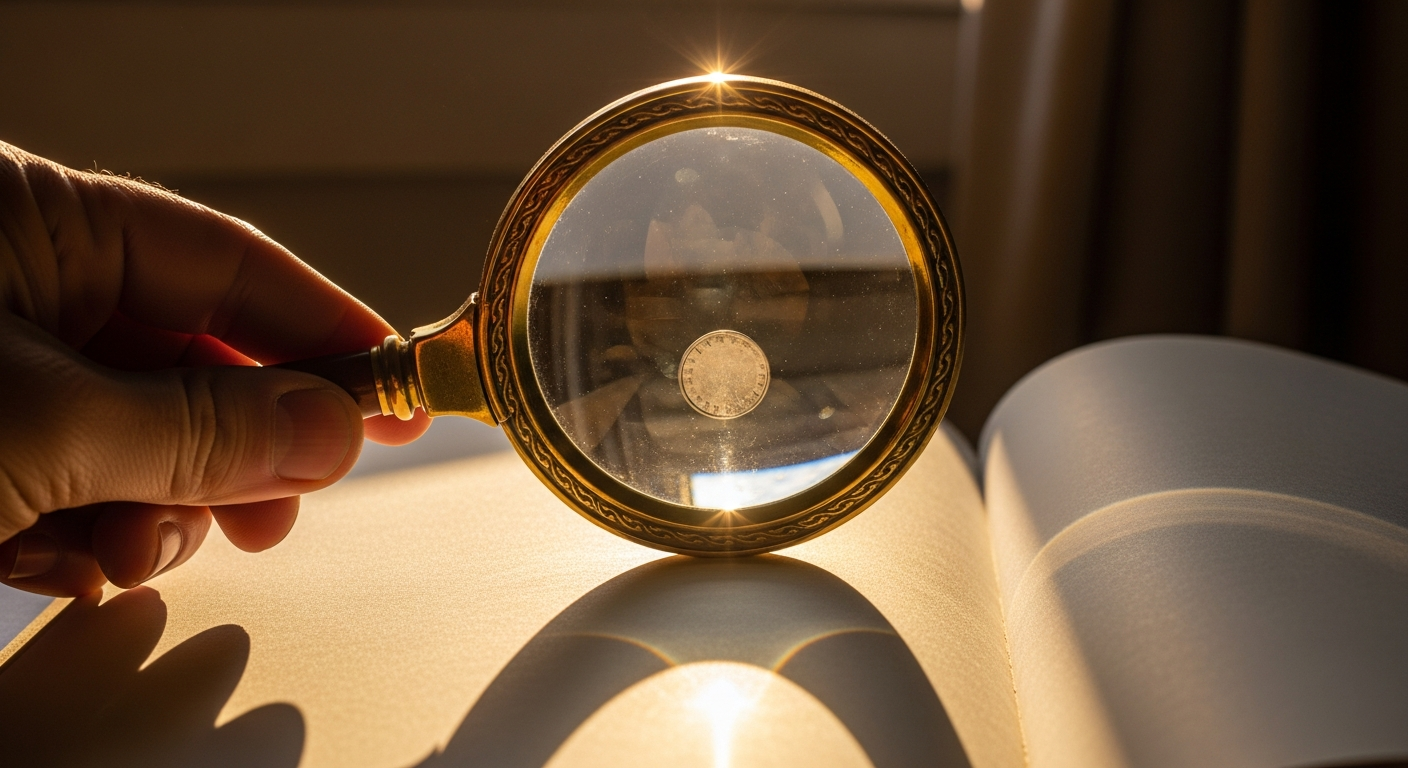
Why a curved piece of glass can create a picture
Look through a magnifying glass, a camera, or your own eyeglasses and something remarkable is happening: curved glass is taking the scattered light bouncing off an object and reassembling it into an organized picture — sometimes larger, sometimes smaller, sometimes flipped upside down. None of this is magic. Every ray of light entering the lens obeys the same refraction rule at both surfaces, and that consistency is exactly what lets us predict, with a plain equation, precisely where the image will land.
A converging (convex) lens is thicker in the middle than at the edges. It bends parallel rays of light inward, so they cross at a single point called the focal point — a real place where light actually meets.
A diverging (concave) lens is thinner in the middle. It bends parallel rays outward, so they spread apart as if they came from a focal point on the same side as the incoming light — light never actually passes through that point.
The distance from the lens to its focal point, on either type, is the focal length, \(f\).
Three rays are all you need
To locate an image without any arithmetic, trace these three rays from the tip of the object through a converging lens:
- A ray parallel to the axis bends through the far focal point.
- A ray through the center of the lens passes straight through, undeflected.
- A ray through the near focal point emerges parallel to the axis.
Wherever these rays cross (or appear to cross, when extended backward) is where the image forms. For a diverging lens, the same three rays are traced but they bend away from the focal points instead of toward them, so they only ever appear to meet on the object's own side.
When the traced rays actually cross and converge, you get a real image: light energy is genuinely concentrated there, which is why you can catch it on a screen or film. The thin-lens equation gives a positive \(d_i\) for these.
When the rays never actually meet but only look like they're coming from a point (because your eye extends them backward), you get a virtual image — the thin-lens equation gives a negative \(d_i\), and no screen placed there would show anything. The image you see through a magnifying glass held close to a page is virtual.
- Start from the thin-lens equation: \(\frac{1}{f} = \frac{1}{d_o} + \frac{1}{d_i}\)
- Solve for \(\frac{1}{d_i}\): \(\frac{1}{d_i} = \frac{1}{10} - \frac{1}{15} = \frac{3}{30} - \frac{2}{30} = \frac{1}{30}\)
- So \(d_i = 30\text{ cm}\). Positive, so the image is real, formed on the opposite side of the lens from the object.
- Magnification: \(m = -\frac{d_i}{d_o} = -\frac{30}{15} = -2\)
- Apply the thin-lens equation: \(\frac{1}{d_i} = \frac{1}{f} - \frac{1}{d_o} = \frac{1}{10} - \frac{1}{5} = \frac{1}{10} - \frac{2}{10} = -\frac{1}{10}\)
- So \(d_i = -10\text{ cm}\). The negative sign means the image is virtual, forming on the same side as the object.
- Magnification: \(m = -\frac{d_i}{d_o} = -\frac{(-10)}{5} = +2\)
It's tempting to memorize "lenses flip images upside down" — but that's only true for a converging lens with the object placed beyond the focal length. Move the object inside \(f\) and the image becomes virtual and upright instead. A diverging lens is even more consistent: no matter where you place a real object, it always produces a virtual, upright, reduced image — never a real one. Always check the sign of \(d_i\) rather than assuming.
Check your understanding
- Converging lenses bend parallel light inward toward a real focal point; diverging lenses spread it outward from a virtual one, defined by their focal length f.
- The thin-lens equation 1/f = 1/do + 1/di connects object distance, image distance, and focal length for any lens, converging or diverging.
- Magnification m = -di/do tells you both the size ratio and the orientation: negative means inverted, positive means upright.
- A positive di means a real image (light actually converges there, projectable on a screen); a negative di means a virtual image (rays only appear to originate there).
🎓 Go deeper: external courses & trusted references
External sites are listed for reference only. This course is independent and has no affiliation with, or endorsement from, the institutions named.