
Work, Energy & Power
Push a box, drop a ball, or climb a flight of stairs — it's all the same currency changing hands.
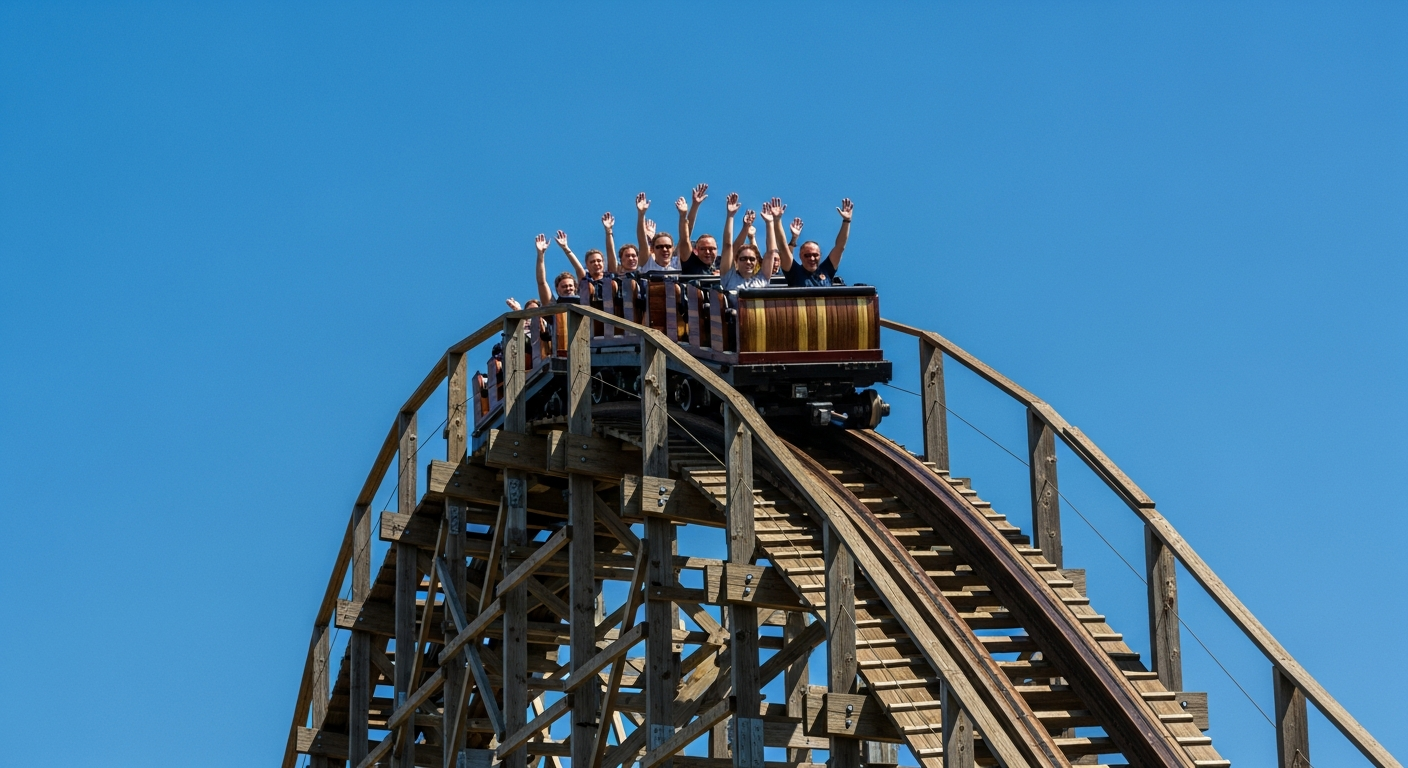
One quantity, many costumes
Here's the trick that makes energy so useful: it's just one thing wearing different outfits. A stretched bow, a boulder at the top of a cliff, a speeding car, a hot cup of coffee — all of these are energy, just stored in different forms. Physics gets remarkably simple once you stop asking "where did the energy come from?" and start asking "what form was it in before, and what form is it in now?"
Work, kinetic energy, and potential energy are just the vocabulary for tracking that bookkeeping. Once you can speak the language, you can predict speeds, heights, and forces without ever touching Newton's second law directly.
In a system where the only forces doing work are conservative ones (like gravity), the total mechanical energy — kinetic plus potential — stays exactly the same. It just keeps trading between the two forms. A falling apple isn't gaining energy from nowhere; it's cashing in potential energy for kinetic energy, dollar for dollar.
Power: the same energy, but how fast?
Two people can lift the same box to the same shelf — same work, same energy transferred. But if one does it in two seconds and the other takes a lazy ten minutes, something is clearly different between them. That "something" is power: the rate at which energy is delivered or converted.
Power is why a small electric motor can still lift a heavy elevator (given enough time), while a sprinter's legs generate enormous power for a very short burst. It's not about how much energy you can produce — it's about how fast you can push it through.
- Choose the bottom of the slope as the reference height, so potential energy there is zero.
- Find the potential energy at the top: \(PE = mgh = 60 \times 9.8 \times 20 = 11{,}760\ \text{J}\).
- Since the slope is frictionless, mechanical energy is conserved: all of that potential energy converts into kinetic energy at the bottom, so \(KE = 11{,}760\ \text{J}\).
- Solve \(\tfrac{1}{2}mv^2 = 11{,}760\) for \(v\): \(v^2 = \dfrac{2 \times 11{,}760}{60} = 392\), so \(v = \sqrt{392} \approx 19.8\ \text{m/s}\).
- Notice the mass canceled out along the way — in the absence of friction or air resistance, a heavier skier and a lighter skier released from the same height arrive at the same speed.
- Find the work done against gravity: \(W = mgh = 50 \times 9.8 \times 4 = 1{,}960\ \text{J}\).
- Divide by the time taken: \(P = \dfrac{W}{t} = \dfrac{1{,}960}{5} = 392\ \text{W}\).
Conservation of mechanical energy only holds when friction and air resistance are negligible — that's why textbook slopes are always suspiciously "frictionless." In the real world, some mechanical energy continuously leaks away as heat and sound. The energy itself is never destroyed (that's the broader law of conservation of energy), but it stops being available as clean, usable kinetic or potential energy. So if a real skier's speed at the bottom comes in a bit lower than your calculation predicts, friction — not a broken formula — is almost always the reason.
Check your understanding
- Work (W = Fd cos θ) is the transfer of energy that happens when a force acts through a distance — a force perpendicular to motion does no work at all.
- Kinetic energy (½mv²) scales with the square of speed, so small speed increases cause much bigger energy increases.
- In a frictionless system, mechanical energy (kinetic + potential) is conserved — energy just trades forms, letting you find unknown speeds or heights without touching forces directly.
- Power (P = W/t) measures how fast energy is transferred, not how much total energy is involved.
🎓 Go deeper: external courses & trusted references
External sites are listed for reference only. This course is independent and has no affiliation with, or endorsement from, the institutions named.