
Observation & Anticipation: Read the Road
Good driving starts before anything happens — with where you're looking and what you expect next. Build the habit of scanning far ahead and reading the road, and hazards stop being surprises.
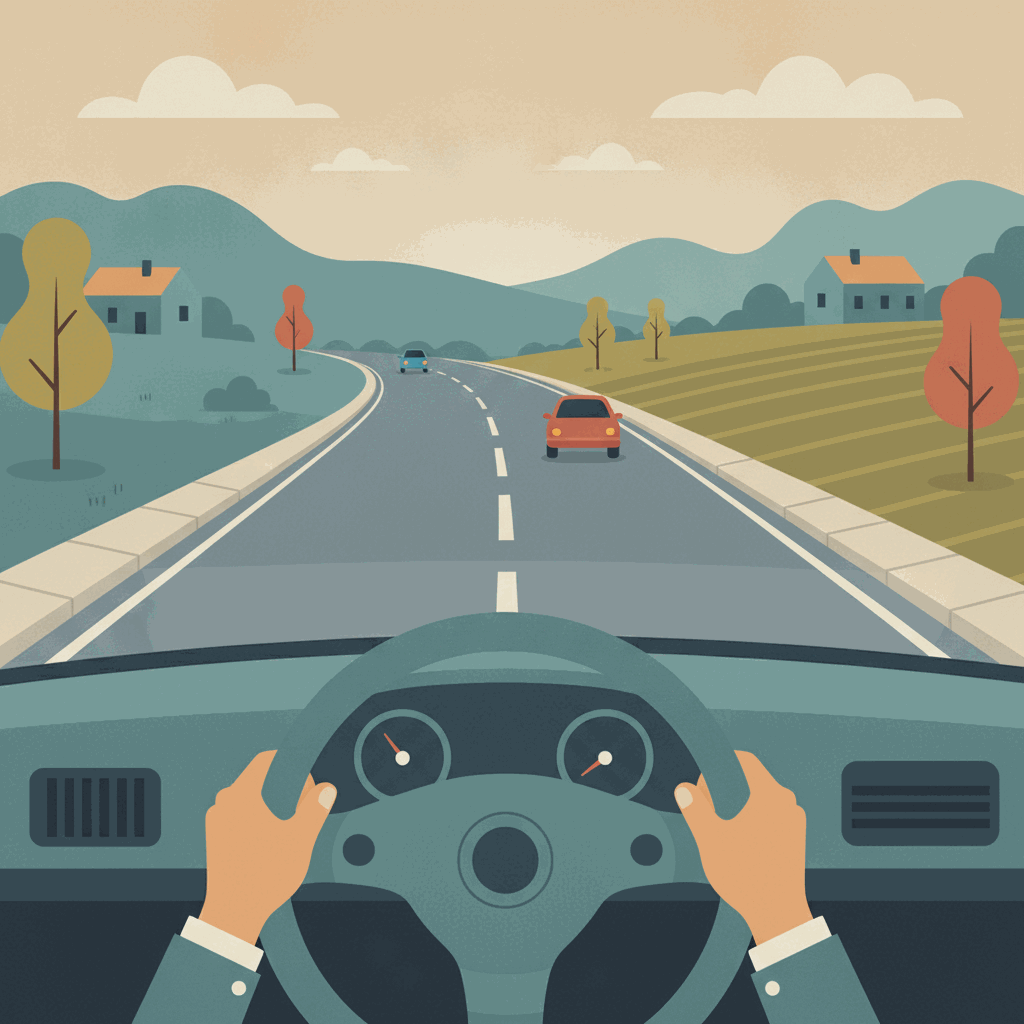
Two learners can be looking at exactly the same road and see completely different things. One sees the car in front and reacts to it. The other sees the car in front, the cyclist two vehicles further on, the ball rolling out from between parked cars, and the brake lights just starting to glow on the hill ahead — and is already easing off the accelerator before anything has actually gone wrong. That difference is observation and anticipation, and it's a skill you build, not a talent you're born with.
Look further than you think you need to
A common new-driver habit is watching the back of the car directly ahead — which means you only find out about a hazard the moment that driver reacts to it. Experienced drivers deliberately look further down the road: past the vehicle in front, to the next junction, the brow of the hill, or the point where the road bends out of sight. On a bend, this often means looking towards the furthest point you can see the road surface, rather than at the verge right in front of your bonnet.
Looking further ahead doesn't mean ignoring what's close — it means your eyes are constantly moving between distances, so nothing arrives as a surprise. The further ahead you're looking, the more time you buy yourself to slow down, change position, or simply confirm that nothing is wrong.
Build the habit of moving your eyes through three zones on a repeating cycle, rather than staring at any single one:
- Far ahead — the road 10-15 seconds away: the next junction, bend, hill or hazard sign.
- Middle distance — the next few vehicles, pedestrians on the pavement, cyclists, parked cars you'll soon pass.
- Close and around — your immediate path, plus regular mirror checks of what's behind and to each side.
A driver who only ever looks at the middle distance misses developing hazards far ahead until it's too late to respond gently.
Building the full picture — not just what's in front
Effective observation is 360 degrees, not just forward. Check your mirrors regularly as a matter of routine — not only when you're about to do something — so you always know roughly what's behind and beside you before you need that information urgently. That habit matters most in the moments before you change speed or direction, which is exactly what the Mirror-Signal-Manoeuvre routine in the next lesson is built around.
Watch for gaps in your information, too. A hedge, a parked van, or a bend can hide a junction, a driveway, or a pedestrian about to step out. Where your view is blocked, that's precisely where you should ease off and be ready to react — treat "I can't see" as a reason to slow down, not a reason to assume it's clear.
Anticipation: predicting what happens next
Anticipation takes everything you observe and asks "what is this road user likely to do in the next few seconds?" You're not required to guess correctly every time — you're building a working expectation you can adjust as new information arrives. Some reliable clues:
- A pedestrian facing the kerb, looking at a phone, or with children or a dog nearby is more likely to step into the road without checking traffic.
- A cyclist glancing over their shoulder is often about to move out or turn — give them room before they need it.
- Brake lights appearing several vehicles ahead tell you to ease off well before you'd otherwise notice anything wrong.
- A vehicle drifting slightly within its lane, or slowing without an obvious reason, may be about to turn even before it signals.
Check your understanding
- Scan far ahead, in the middle distance, and close around you on a repeating cycle — don't fix on the car directly in front.
- Check mirrors regularly as routine, not just when you're about to act, so you always have a current picture of what's behind and beside you.
- Treat a blocked view (parked cars, hedges, bends) as a reason to slow down, not a reason to assume the road is clear.
- Anticipation means reading clues — a pedestrian's posture, a cyclist's glance, distant brake lights — to predict what happens next before it does.
Frequently asked questions
What is the difference between observation and anticipation when driving?
How far ahead should you be looking while driving?
What should I do if I can't see past a parked van or a hedge at a junction?
Put what you've learned to the test with our practice exam — hundreds of exam-style questions with instant explanations, in a realistic format.
Try the UK Theory Practice Test →Independent educational content — not affiliated with, endorsed by, or connected to the DVSA, DVLA, or any government body. This is study material, not legal advice; always confirm current rules in the official Highway Code.