
Catalysis
A shortcut through the energy barrier — speeding a reaction without being used up, and without changing where it ends.
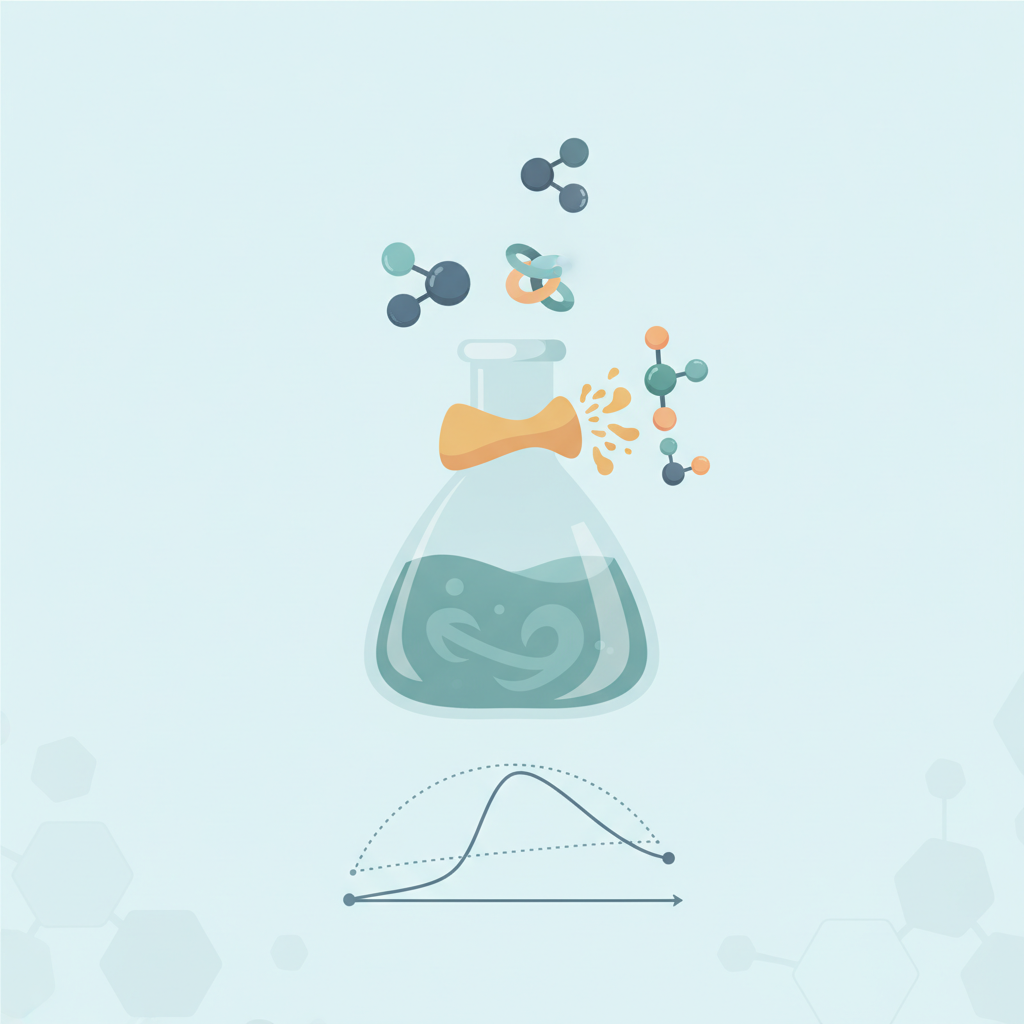
The catalytic converter under your car takes toxic exhaust gases and turns them harmless in a fraction of a second — using a metal that is never consumed. Your own body runs thousands of such tricks every moment, with enzymes. That is catalysis: faster reactions, for free.
A lower road over the mountain
A catalyst is a substance that speeds up a reaction without being used up in the process. It works not by pushing molecules harder but by opening a different route — a mechanism with a lower activation energy. Same reactants, same products, but a smaller hill to climb.
Through the Arrhenius equation, a lower Ea means a bigger fraction of molecules can react at a given temperature, so k rises and the reaction accelerates — often by orders of magnitude.
It changes the path, not the endpoints
On the energy profile, a catalyst carves a lower peak between the same reactants and products. Because the reactant and product energies are untouched, the reaction's ΔH is unchanged — only the barrier between them is lower. Faster to get there; same place you arrive.
Three flavours of catalyst
- Homogeneous — in the same phase as the reactants (e.g. an acid dissolved in the reacting solution).
- Heterogeneous — in a different phase, usually a solid surface that gases or liquids react on. The metals in a catalytic converter are heterogeneous catalysts.
- Enzymes — nature's protein catalysts, astonishingly fast and specific; they run the biochemistry of every living cell.
- A catalyst provides a new pathway with a lower barrier, but it does not change the energies of the reactants or the products.
- ΔH depends only on the reactant and product energies (their difference), not on the height of the barrier between them.
- So ΔH is completely unchanged — the change in ΔH is 0.
- A catalyst lowers the barrier but leaves the reactant and product energies alone.
- ΔH = (product energy) − (reactant energy), neither of which the catalyst touches.
- So ΔH changes by 0 kJ/mol — a catalyst speeds the reaction, it does not make it more exothermic or shift equilibrium.
Check your understanding
- A catalyst speeds a reaction by providing a lower-activation-energy pathway.
- It is not consumed — it is regenerated and never appears in the overall equation.
- It speeds forward and reverse equally, so it does NOT shift equilibrium or change K.
- It leaves ΔH unchanged: catalysts change kinetics, not thermodynamics.
- Types: homogeneous (same phase), heterogeneous (surface), and enzymes (biological).
🎓 Go deeper: external courses & trusted references
External sites are listed for reference only. This course is independent and has no affiliation with, or endorsement from, the institutions named.