Dynamic Equilibrium & the Equilibrium Constant

Why a reaction that looks 'finished' is actually still running โ€” full speed, in both directions.

High schoolIntro Gen ChemUni Year 1
โฑ๏ธ About 20 min
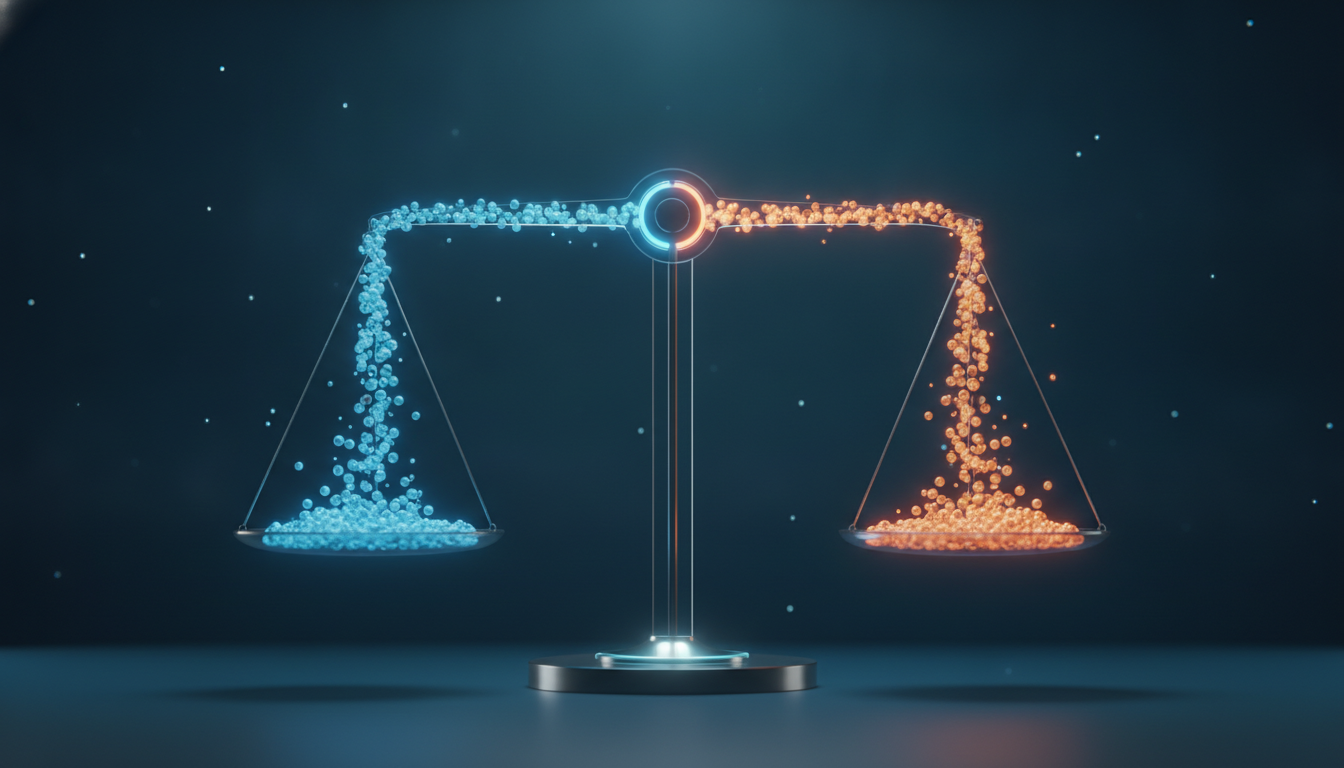
Dynamic Equilibrium & the Equilibrium Constant โ€” illustration
Illustration only โ€” the live simulation below shows the real, continuous molecular motion of equilibrium.

Seal a reaction in a flask and wait. After a while the colour stops changing and it looks like nothing is happening. But zoom in and the reaction is as busy as ever โ€” molecules are converting back and forth constantly. It only looks still because two opposite processes are perfectly matched.

๐Ÿ’ก
The big idea: At equilibrium the forward and reverse reactions are still happening โ€” at EQUAL rates. Concentrations stop changing, but the molecules never stop reacting. Equilibrium is a dynamic balance, not a dead stop.
๐ŸŽฏ By the end, you'll be able to
  • Explain equilibrium as equal forward and reverse rates (not a stopped reaction)
  • Write the equilibrium constant expression K for a reaction
  • Interpret what a large or small K says about a reaction's position
  • Recognise that K changes only with temperature โ€” not with concentration
๐Ÿ“Ž Helpful to know first

A reaction that runs both ways

Many reactions are reversible: products can turn back into reactants. We write them with a double arrow: A โ‡Œ B. At the start there's lots of A, so the forward reaction (A โ†’ B) is fast and the reverse (B โ†’ A) is slow. As B builds up, the reverse speeds up and the forward slows down.

Eventually the two rates become equal. From that moment the amounts of A and B stop changing โ€” the system is at equilibrium. But crucially, both reactions are still running at full speed; they just cancel out. Watch it happen:

๐ŸŽฎ Interactive: Reversible-Reaction Sandbox LIVE
Predict first: Before you start it โ€” predict: once the numbers of A and B stop changing, have the molecules stopped converting? Watch closely and see.

An interactive box of particles converting between species A and B. Forward and reverse rate readouts converge to equal values while particles keep changing colour, and a mini graph shows the fraction of B levelling off at equilibrium.

Every particle can flip Aโ†’B or Bโ†’A each moment. Watch the forward and reverse rates converge and the fraction of B level off โ€” yet the particles never stop converting. That is dynamic equilibrium. Try the '+20 A' button to disturb it and watch it re-balance.
โš ๏ธ The #1 misconception
Equilibrium does not mean the reaction has stopped, and it does not mean the amounts of reactant and product are equal. It means the forward and reverse rates are equal. The concentrations are constant, but usually not equal to each other.

Measuring the balance point: K

The equilibrium constant K captures where the balance sits. For a general reaction aA + bB โ‡Œ cC + dD, K is the products over the reactants, each raised to its coefficient:

\[ K = \frac{[\text{C}]^c\,[\text{D}]^d}{[\text{A}]^a\,[\text{B}]^b} \]
Products on top, reactants on the bottom, exponents = the balancing coefficients.
โœจ Reading K
K > 1: products are favoured (the reaction goes far to the right). K < 1: reactants are favoured. K depends only on temperature โ€” changing concentrations shifts the position but does not change K itself.
๐Ÿ“ Worked example: Write the equilibrium constant expression for Nโ‚‚(g) + 3Hโ‚‚(g) โ‡Œ 2NHโ‚ƒ(g).
  1. Products over reactants: NHโ‚ƒ on top; Nโ‚‚ and Hโ‚‚ on the bottom.
  2. Apply the coefficients as exponents: NHโ‚ƒ has coefficient 2, Hโ‚‚ has 3, Nโ‚‚ has 1.
  3. K = [NHโ‚ƒ]ยฒ / ([Nโ‚‚] ยท [Hโ‚‚]ยณ).
โœ“ K = [NHโ‚ƒ]ยฒ / ([Nโ‚‚][Hโ‚‚]ยณ).
โœ๏ธ Practice: For the reaction A โ‡Œ B at equilibrium, [A] = 0.20 mol/L and [B] = 0.60 mol/L. What is K? (K = [B] / [A].)
Solution
  1. K = [B] / [A] for A โ‡Œ B (coefficients are both 1).
  2. = 0.60 / 0.20.
  3. = 3.0. K > 1, so product B is favoured at this temperature.

Check your understanding

1. At equilibrium, what is true about the forward and reverse reactions?
Equilibrium is dynamic: forward and reverse continue at equal rates, so concentrations stay constant while molecules keep reacting.
2. Which change alters the value of the equilibrium constant K?
Only temperature changes K. Concentration changes shift the position of equilibrium but K is unchanged; a catalyst speeds both directions equally and doesn't change K either.
3. A reaction has K = 0.001. At equilibrium the mixture is mostlyโ€ฆ
K < 1 means the bottom (reactants) dominates, so at equilibrium the mixture is mostly reactants โ€” the reaction barely proceeds.
โœ… Key takeaways
  • Reversible reactions (A โ‡Œ B) run both ways; equilibrium is when the two rates become equal.
  • Equilibrium is DYNAMIC โ€” concentrations are constant, but molecules keep reacting.
  • Equilibrium is not the same as equal concentrations of reactant and product.
  • K = products/reactants (with coefficients as exponents); K > 1 favours products.
  • K changes only with temperature โ€” not with concentration or a catalyst.
โžก๏ธ If you disturb a system at equilibrium โ€” add a reactant, change the temperature โ€” it shifts to a new balance. The rule that predicts which way it moves is Le Chรขtelier's principle, coming up next.
Want to test yourself on this? Try the Chemistry practice test โ†’