
Phase Changes & Latent Heat
Why a melting ice cube and a boiling kettle both stall at a fixed temperature no matter how much heat you throw at them.
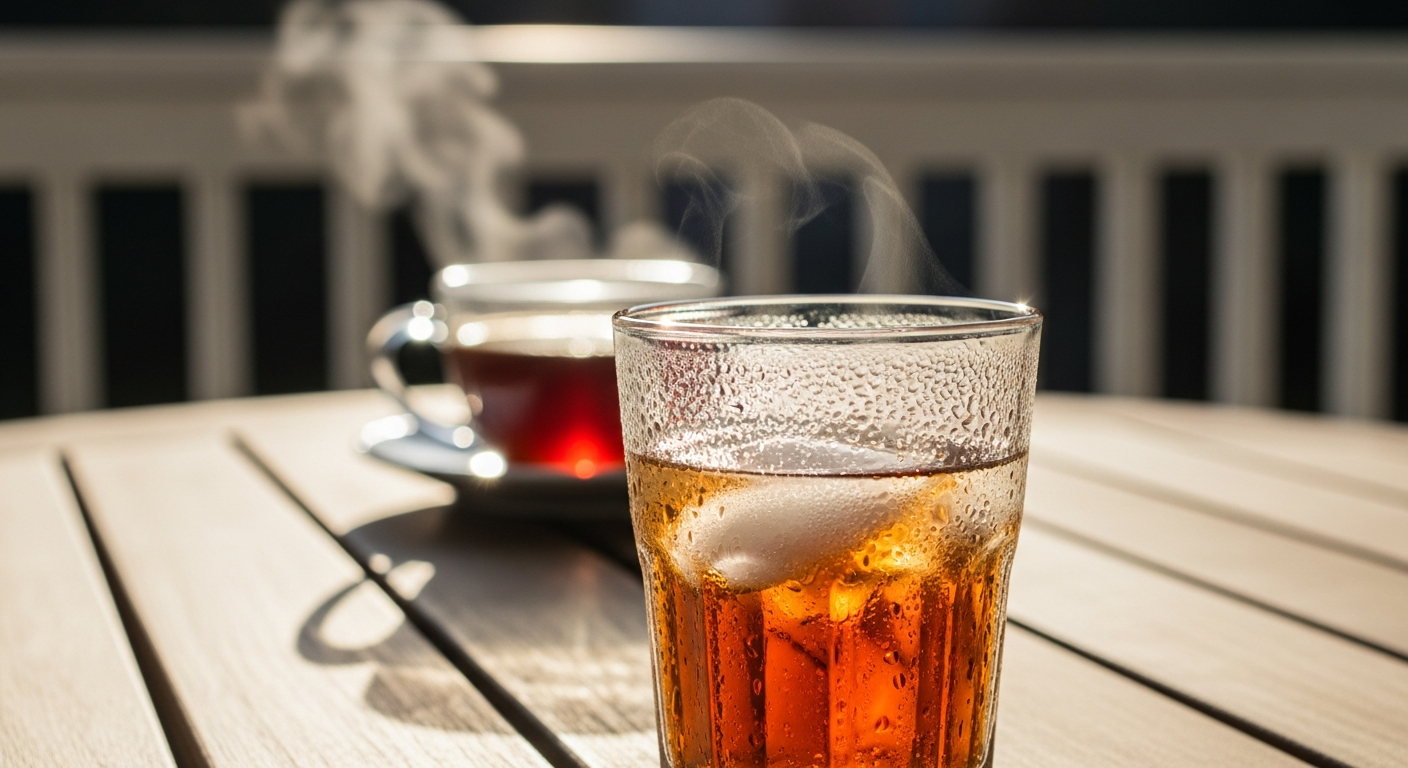
The Ice Cube That Refuses to Warm Up
Drop an ice cube into a glass of lemonade on a hot day and something strange happens: as it melts, the water right around it stays stubbornly at the same temperature — 0°C — until every last sliver of ice is gone. Crank the stove up under a pot of boiling water and hold it there for ten more minutes: the water never gets hotter than 100°C. It just boils away faster. So where is all that extra heat going, if not into raising the temperature?
This is the quiet secret of phase changes: heat flowing in doesn't always show up as a higher thermometer reading. Sometimes it's spent somewhere you can't see directly — prying apart the bonds that hold molecules to their neighbors.
Temperature tracks the average kinetic energy of jiggling, jostling molecules. But whether a substance is solid, liquid, or gas depends on something else entirely: how tightly its molecules are bound to their neighbors. Melting and boiling both require energy to break those bonds — and while that breaking is underway, every joule you add goes into separating molecules, not speeding them up. That's why the thermometer freezes in place at 0°C or 100°C until the whole sample has finished changing phase.
Plot temperature against heat added for a block of ice starting below freezing, and you get a signature zig-zag: a rising slope (ice warming up), then a flat plateau (ice melting at 0°C), then another rising slope (liquid water warming up), then a second flat plateau (water boiling at 100°C), then a final rising slope (steam warming further). Notice the boiling plateau stretches much farther along the heat axis than the melting plateau — vaporizing water simply costs far more energy than melting it, because boiling has to fully separate molecules into a gas while melting only has to loosen their rigid, locked-in arrangement.
- Step 1 — warm the ice from −10°C to 0°C: Q₁ = mcΔT = 20 g × 2.09 J/g°C × 10°C = 418 J.
- Step 2 — melt the ice at 0°C: Q₂ = mL_f = 20 g × 334 J/g = 6,680 J.
- Step 3 — warm the liquid water from 0°C to 100°C: Q₃ = mcΔT = 20 g × 4.18 J/g°C × 100°C = 8,360 J.
- Step 4 — boil the water into steam at 100°C: Q₄ = mL_v = 20 g × 2260 J/g = 45,200 J.
- Add all four stages: 418 + 6,680 + 8,360 + 45,200 = 60,658 J.
- Melting: Q = mL_f = 100 g × 334 J/g = 33,400 J = 33.4 kJ.
- Boiling: Q = mL_v = 100 g × 2260 J/g = 226,000 J = 226 kJ.
- Compare: 226 kJ ÷ 33.4 kJ ≈ 6.8.
Q = mcΔT and Q = mL solve different problems, and reaching for the wrong one is the most common mistake here. If the substance is actually melting or boiling, ΔT is zero — plugging that into Q = mcΔT just hands you zero, which is meaningless. Use Q = mL only for the phase-change stretch itself, and Q = mcΔT only for stretches where the substance stays in one phase and its temperature is genuinely rising or falling. Also watch your units: L and c values are specific to the substance (water's numbers won't work for, say, copper or ethanol), and it's easy to lose a factor of 1000 mixing up grams with kilograms or joules with kilojoules.
Check your understanding
- Temperature tracks molecular motion (kinetic energy); phase changes are about breaking or forming molecular bonds (potential energy) — the same heat can't do both jobs at once, which is why temperature holds constant during melting and boiling.
- Use Q = mcΔT for heat that changes temperature within a single phase, and Q = mL for heat that drives a phase change at constant temperature — mixing the two up is the most common error.
- Vaporization takes far more energy than fusion for the same substance (water's L_v is nearly 7 times its L_f) because turning liquid into gas fully separates molecules, while melting only loosens a solid's rigid structure.
- A heating curve's flat plateaus mark phase changes; its sloped segments mark ordinary temperature rise or fall within one phase.
🎓 Go deeper: external courses & trusted references
External sites are listed for reference only. This course is independent and has no affiliation with, or endorsement from, the institutions named.