
Mass–Energy Equivalence
A sliver of missing mass inside a star is the same thing as the sunlight on your face — E=mc² is the exchange rate between them.
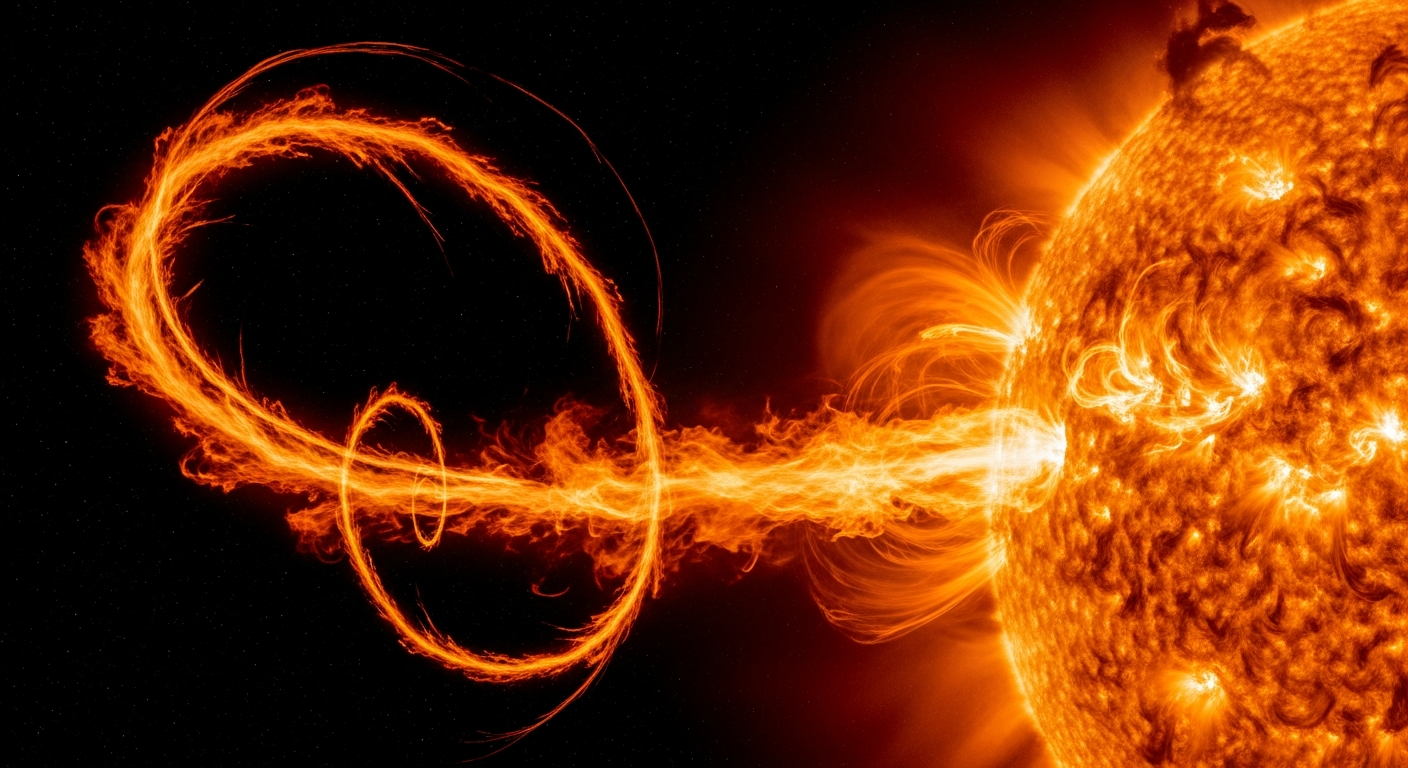
The energy that was once mass
Every second, the Sun's core fuses hydrogen into helium, and the resulting helium nuclei weigh very slightly less than the hydrogen that made them. That missing mass doesn't vanish — it reappears, moments later, as the light and heat radiating outward. Einstein's insight was that this isn't a special nuclear trick; it's a universal fact about nature. Mass is a form of energy, sitting there even when an object is perfectly still. \(E=mc^2\) tells you exactly how much.
Every object at rest carries an energy content \(E_0 = mc^2\) simply because it has mass \(m\). This is called its rest energy. Nothing needs to happen to the object for this energy to exist — it's baked into having mass at all. Because \(c\) is about \(3\times10^8\) m/s, \(c^2\) is roughly \(9\times10^{16}\,\text{m}^2/\text{s}^2\) — an almost absurdly large conversion factor. That's why even a gram of matter corresponds to a huge amount of energy.
Why nothing with mass can catch a light beam
Look again at \(E=\gamma mc^2\). As \(v\) creeps toward \(c\), the term \(v^2/c^2\) creeps toward 1, so \(1-v^2/c^2\) shrinks toward zero — and \(\gamma\), sitting under a square root in the denominator, shoots toward infinity. That means the kinetic energy \((\gamma-1)mc^2\) needed to keep accelerating a massive object also shoots toward infinity. There's no finite amount of energy — not all the fuel in the universe — that gets a massive object all the way to \(c\). Photons, by contrast, have zero rest mass, so their energy comes entirely from motion (\(E=pc\)) with no contradiction: massless is precisely what lets them travel at \(c\).
- Rest energy: \(E_0 = mc^2\).
- \(E_0 = (1.67\times10^{-27}\,\text{kg})(3.00\times10^{8}\,\text{m/s})^2\)
- \(c^2 = 9.00\times10^{16}\,\text{m}^2/\text{s}^2\), so \(E_0 = 1.67\times10^{-27} \times 9.00\times10^{16} \approx 1.50\times10^{-10}\,\text{J}\)
- Convert to eV by dividing by \(1.60\times10^{-19}\,\text{J/eV}\): \(E_0 \approx \dfrac{1.50\times10^{-10}}{1.60\times10^{-19}} \approx 9.4\times10^{8}\,\text{eV} = 938\,\text{MeV}\)
- Lorentz factor: \(\gamma = \dfrac{1}{\sqrt{1-v^2/c^2}} = \dfrac{1}{\sqrt{1-0.64}} = \dfrac{1}{\sqrt{0.36}} = \dfrac{1}{0.6} \approx 1.67\)
- Total energy: \(E = \gamma mc^2 \approx 1.67 \times 0.511\,\text{MeV} \approx 0.852\,\text{MeV}\)
- Kinetic energy is everything beyond rest energy: \(KE = (\gamma-1)mc^2 \approx 0.667 \times 0.511\,\text{MeV} \approx 0.341\,\text{MeV}\)
It's tempting to picture mass vanishing and energy appearing out of nowhere, but total energy — including whatever is stored as rest mass — is always conserved. In a nuclear reaction, the total rest mass of the products is measurably less than that of the reactants; this difference, the mass defect \(\Delta m\), reappears as kinetic energy and radiation according to \(\Delta E = \Delta m\,c^2\). Nothing is created or destroyed — energy just changes which form it's stored in. Also remember that \(E=mc^2\) itself is the rest-energy special case; a moving object's full energy is \(E=\gamma mc^2\).
Check your understanding
- E=mc² says mass and energy are the same physical quantity, just measured in different units — c² is the huge conversion factor between them.
- Total relativistic energy is E=γmc²; kinetic energy is the extra (γ−1)mc² an object gains from motion, on top of its rest energy.
- Because γ→∞ as v→c, the energy needed to accelerate a massive object toward light speed grows without bound — that's the real reason nothing with mass ever reaches c.
- Nuclear reactions release energy by converting a measurable 'mass defect' (Δm) into kinetic energy and radiation via ΔE=Δmc² — energy is conserved, not created from nothing.
🎓 Go deeper: external courses & trusted references
External sites are listed for reference only. This course is independent and has no affiliation with, or endorsement from, the institutions named.