
Colour & the Electromagnetic Spectrum
The rainbow you can see is just one thin slice of a wave family that stretches from radio towers to the inside of a nuclear reactor.
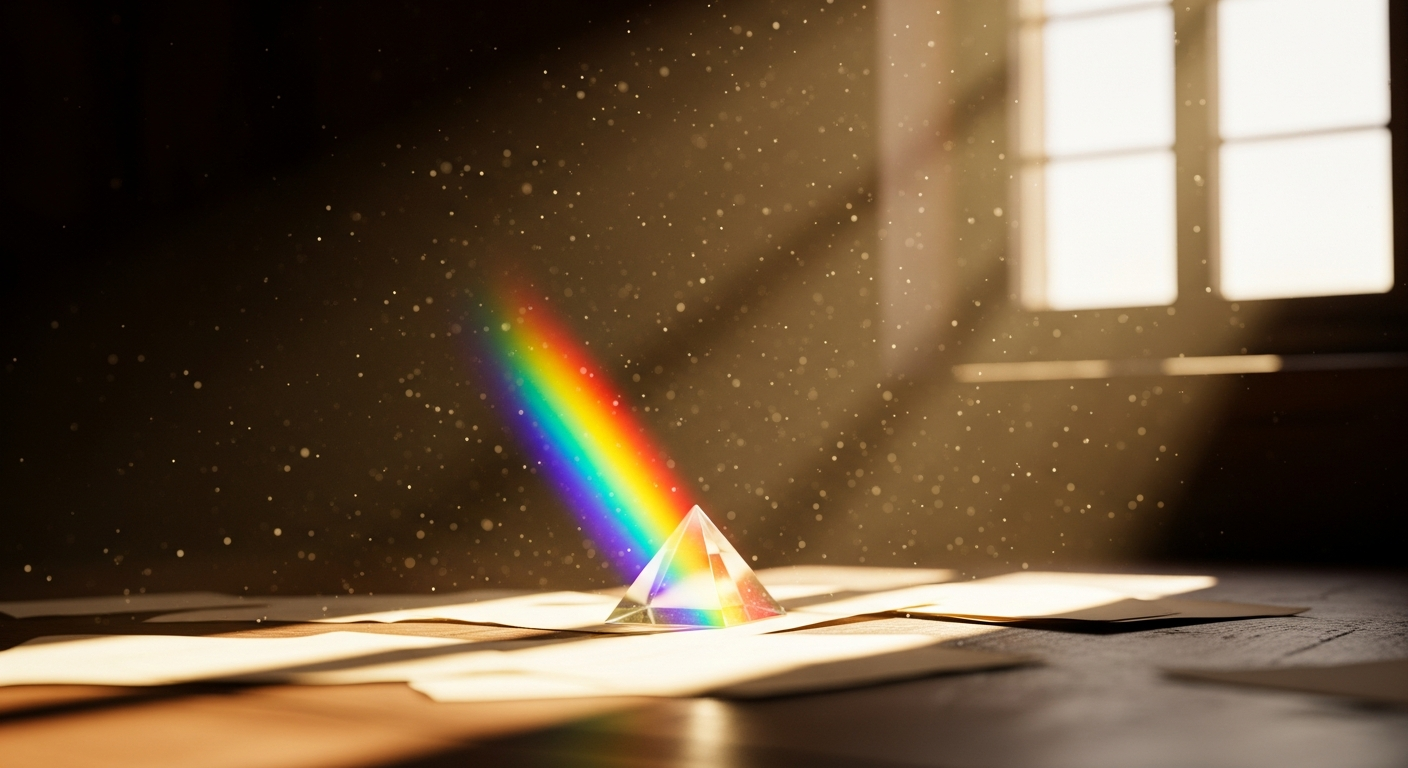
A rainbow is a message written in wavelengths
Hold a prism up to sunlight and it fans out into red, orange, yellow, green, blue, violet. Nothing is being added — the prism is simply sorting light that was already a mixture, the way a sieve sorts pebbles by size. Every colour you have ever seen corresponds to a specific \( \lambda \) (wavelength) of light, somewhere between about 400 and 700 nanometres. But visible light is a rounding error. It's a narrow band inside a vastly larger family of waves — radio, microwave, infrared, ultraviolet, X-ray, gamma — that differ from visible light in exactly one respect: how tightly their oscillations are packed together.
Radio waves, light, and gamma rays are all electromagnetic waves: a self-propagating ripple of electric and magnetic fields. In a vacuum (and to good approximation in air) every single one of them travels at the same speed, \( c \approx 3.00 \times 10^8 \) m/s. Since speed is fixed, wavelength and frequency are locked in a seesaw: stretch the wavelength out and the frequency must drop, squeeze the wavelength down and the frequency must climb. That's the entire spectrum — one dial, wavelength, turned from kilometres down to the width of an atomic nucleus.
- Convert to metres: \( \lambda = 700\text{ nm} = 700 \times 10^{-9}\text{ m} = 7.00 \times 10^{-7}\text{ m} \)
- Rearrange \( c = f\lambda \) to solve for frequency: \( f = \dfrac{c}{\lambda} \)
- Plug in numbers: \( f = \dfrac{3.00 \times 10^{8}}{7.00 \times 10^{-7}} \)
- Divide: \( 3.00/7.00 = 0.4286 \), and \( 10^{8}/10^{-7} = 10^{15} \)
- Combine: \( f = 0.4286 \times 10^{15} = 4.29 \times 10^{14}\text{ Hz} \)
- Convert to Hz: \( f = 2.4\text{ GHz} = 2.4 \times 10^{9}\text{ Hz} \)
- Rearrange \( c = f\lambda \) to solve for wavelength: \( \lambda = \dfrac{c}{f} \)
- Plug in numbers: \( \lambda = \dfrac{3.0 \times 10^{8}}{2.4 \times 10^{9}} \)
- Divide: \( 3.0/2.4 = 1.25 \), and \( 10^{8}/10^{9} = 10^{-1} \)
- Combine: \( \lambda = 1.25 \times 10^{-1}\text{ m} = 0.125\text{ m} = 12.5\text{ cm} \)
Because wavelength sets how a wave interacts with matter, each band of the spectrum ends up doing a completely different job in daily life. Radio waves (centimetres to kilometres) slip through walls and carry broadcast signals and WiFi. Microwaves (centimetres) are absorbed efficiently by water molecules, which is exactly why they cook food and why radar and phone signals use them. Infrared is radiated by anything warm — it's why night-vision goggles and TV remotes work. Visible light is the narrow band your eyes evolved to detect, tuned to the wavelengths the sun puts out most strongly. Ultraviolet carries enough energy to trigger vitamin D production in skin, and enough to damage skin cells with overexposure. X-rays punch through soft tissue but not bone, which is why they're used for imaging. Gamma rays, the shortest wavelength of all, come from the nucleus itself and carry so much energy per photon that they can tear electrons off atoms entirely.
Because \( E = hf \), the danger of an EM wave to living tissue tracks its frequency, not its intensity alone. Radio and microwave photons are low-energy — they can heat tissue if intense enough (think of a microwave oven) but they don't have enough energy per photon to strip electrons from atoms. Ultraviolet, X-ray, and gamma photons are ionizing radiation: energetic enough to knock electrons loose and damage DNA, which is why UV causes sunburn and skin cancer risk, and why X-ray and gamma exposure is carefully limited and shielded in medical and industrial settings.
Check your understanding
- Every electromagnetic wave — radio, light, gamma rays — travels at the same speed c, so wavelength and frequency are linked by c = fλ.
- Colour is simply the human eye's way of reporting wavelength within the narrow 400–700 nm visible band.
- Moving from radio to gamma rays, wavelength shrinks, frequency rises, and photon energy (E = hf) rises with it — which is why each band has a different practical use.
- Ionizing bands (UV, X-ray, gamma) carry enough energy per photon to damage DNA, while radio and microwave photons do not, no matter how intense the beam.
🎓 Go deeper: external courses & trusted references
External sites are listed for reference only. This course is independent and has no affiliation with, or endorsement from, the institutions named.