
Wave–Particle Duality
A single electron, fired alone through two slits, still "knows" about both of them — and that changes what "particle" means.
Two centuries of arguing about light
For a long time, physicists fought over whether light was a wave or a stream of particles. Newton bet on particles; Young's double-slit experiment in 1801 showed clean interference fringes — alternating bands of light and dark — which seemed to settle things firmly in favor of waves. Then came the photoelectric effect, which only made sense if light arrived in discrete packets of energy: photons. Light, it turned out, was both. In 1924, a graduate student named Louis de Broglie asked an audacious question: if light can act like particles, can particles like electrons act like waves? The answer, confirmed by experiment, changed physics for good.
The experiment that still feels impossible
Here is the version that matters most: send electrons through a double slit one at a time, slow enough that only one electron is ever in flight. Each electron hits the detector screen as a single, localized dot — exactly like a particle should. There is no way to predict exactly where any individual dot will land. But let the experiment run for thousands of electrons, and the dots do not pile up randomly. They accumulate into the same interference pattern of bright and dark bands you would get from overlapping water waves. Each electron, alone, behaved as if it took both paths through the slits and interfered with itself.
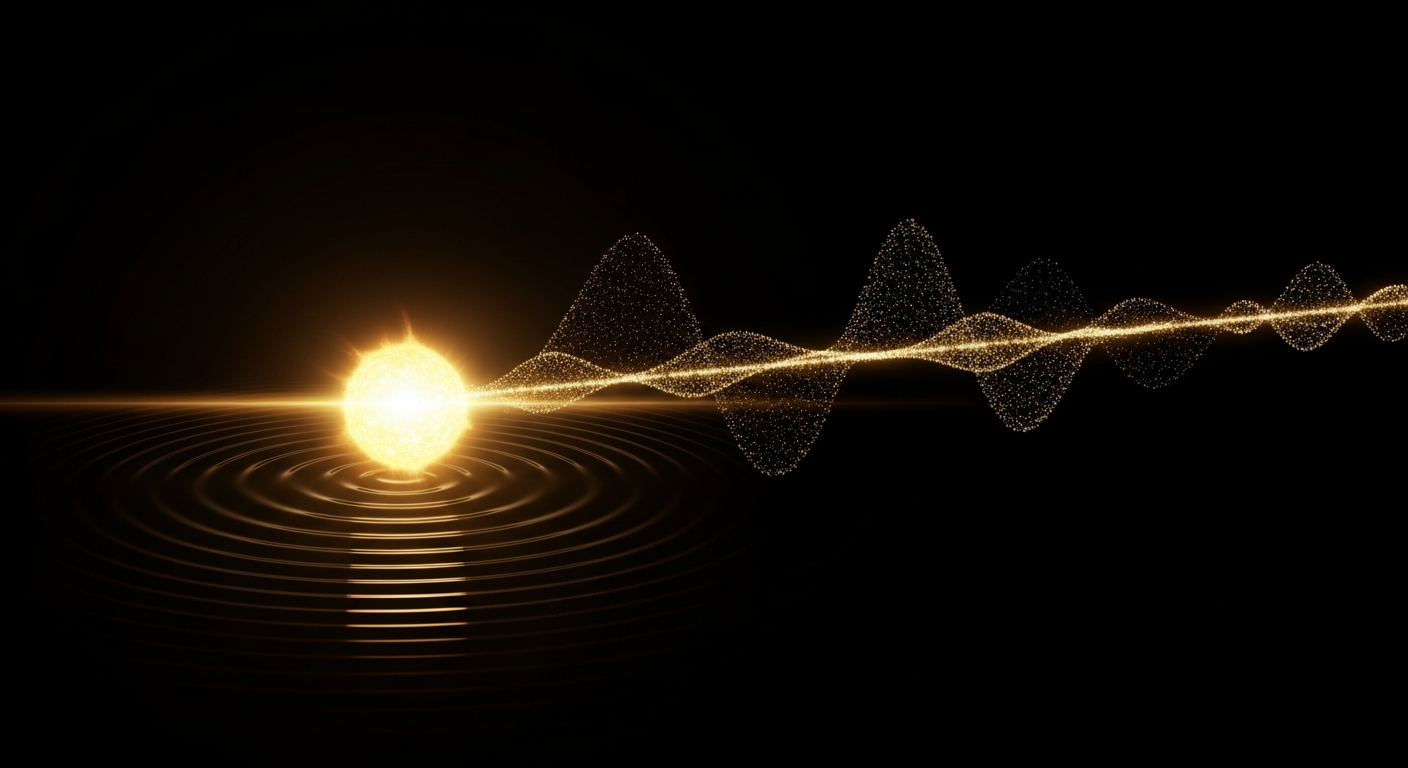
Wave–particle duality means matter and light are not exclusively "wave" or "particle" — they are quantum objects whose behavior is governed by a wave of probability, but which are always detected as discrete, localized events. Light shows this (photons); so does matter (electrons, atoms, even large molecules).
What the pattern is really telling you
The interference pattern is a map of probability. At each point on the screen, the wave associated with the particle can arrive in phase with itself after passing both slits (bright fringe, high probability) or out of phase (dark fringe, near-zero probability). Cover one slit, and the interference term disappears — you get a simple particle-like pile-up instead, no fringes. That single change, from two open slits to one, is the cleanest evidence that the wave nature is doing real physical work in the outcome, not just describing our ignorance of a hidden path.
- Find the kinetic energy gained: \(KE = eV = (1.602\times10^{-19}\,\text{C})(100\,\text{V}) = 1.602\times10^{-17}\,\text{J}\)
- Solve for speed from \(KE = \frac{1}{2}mv^2\): \(v = \sqrt{\dfrac{2KE}{m}} = \sqrt{\dfrac{2(1.602\times10^{-17})}{9.109\times10^{-31}}} \approx 5.93\times10^{6}\,\text{m/s}\)
- Find momentum: \(p = mv = (9.109\times10^{-31})(5.93\times10^{6}) \approx 5.40\times10^{-24}\,\text{kg·m/s}\)
- Apply de Broglie's relation: \(\lambda = \dfrac{h}{p} = \dfrac{6.626\times10^{-34}}{5.40\times10^{-24}} \approx 1.23\times10^{-10}\,\text{m}\)
- Find momentum: \(p = mv = (0.145\,\text{kg})(40\,\text{m/s}) = 5.80\,\text{kg·m/s}\)
- Apply de Broglie's relation: \(\lambda = \dfrac{h}{p} = \dfrac{6.626\times10^{-34}}{5.80} \approx 1.14\times10^{-34}\,\text{m}\)
It's tempting to picture a particle physically morphing between wave and particle forms. Cleaner way to think about it: every quantum object always has a wave of probability associated with it (governed by \(\lambda = h/p\)), and every measurement always registers a localized, particle-like event. The wave does not "become" the particle — it sets the odds of where the particle-like detection will happen. Also note: you do not need a beam of many particles at once for interference. Fire electrons one at a time, minutes apart, and the fringes still build up — each electron interferes with itself, not with the others.
Check your understanding
- Wave–particle duality means every particle of matter and light carries an associated wave, but is always detected as a localized, particle-like event.
- The de Broglie wavelength λ = h/p (or h/mv) applies to everything with momentum — electrons, atoms, even baseballs — not just light.
- In the single-particle double-slit experiment, individual particles land unpredictably, but their accumulated pattern shows interference: each particle interferes with itself, not with others.
- Wave effects only show up when λ is comparable to the size of the relevant slits or obstacles, which is why electrons diffract but everyday objects never do.
🎓 Go deeper: external courses & trusted references
External sites are listed for reference only. This course is independent and has no affiliation with, or endorsement from, the institutions named.