
Measurement & Uncertainty
Every measurement is a best guess with a margin of doubt — learn to state that margin honestly, and read it correctly off any instrument you'll ever pick up.
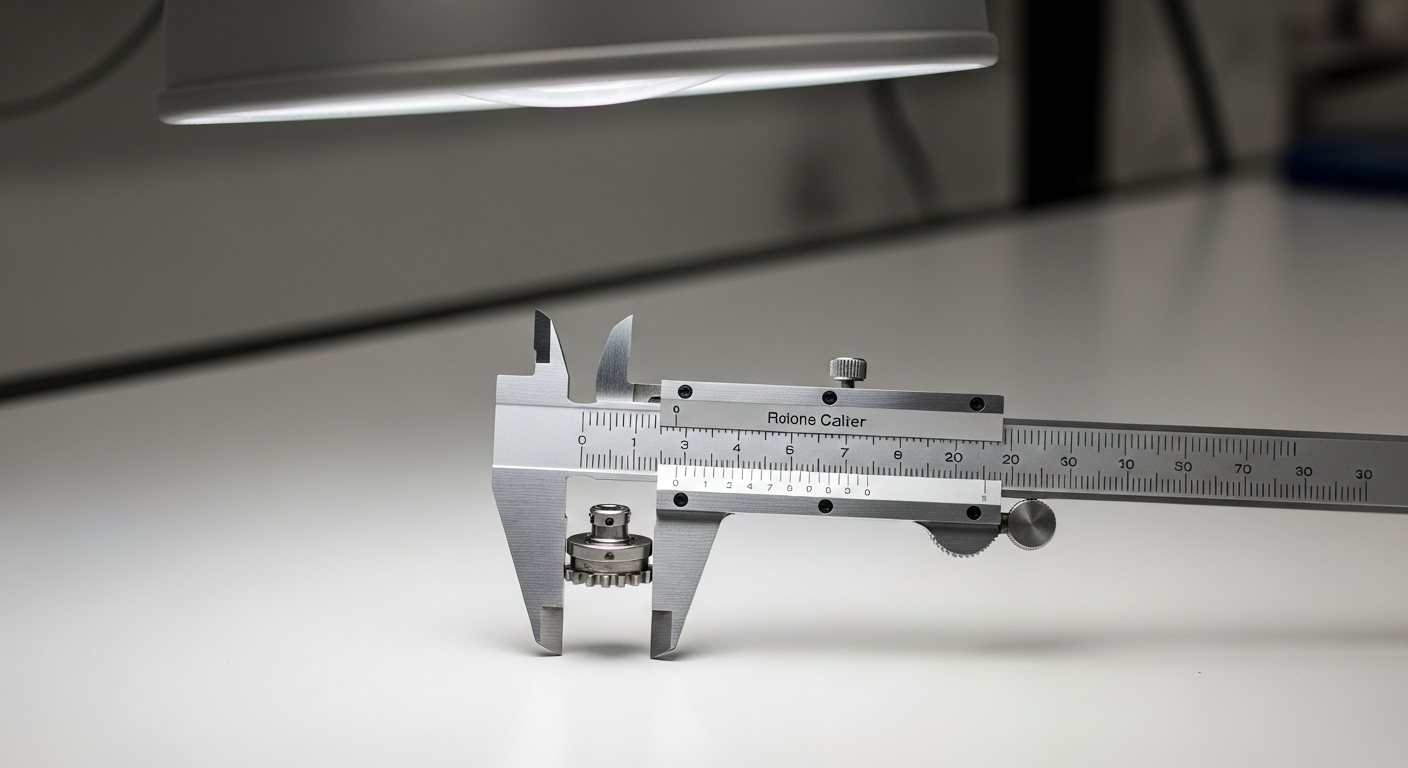
No measurement is perfect
Pick up any ruler and measure the length of your pencil. You'll get an answer — but is it exactly right? Almost certainly not. The true length of that pencil has infinitely many decimal places, and no ruler, no matter how fine its markings, can pin down every one of them.
That's not a flaw in your technique — it's a fact about measurement itself. Every instrument has a limit to how finely it can distinguish one value from another, and every human eye has a limit to how precisely it can judge a position on a scale. The honest thing to do isn't to pretend your number is perfect. It's to say clearly how far you trust it.
A measurement isn't complete until it tells you two things: the value, and how much doubt surrounds it. Significant figures are a shorthand way of showing that doubt inside the number itself; a stated uncertainty (like ± 0.05 cm) makes it explicit. Learning to handle both is what separates a careful measurement from a guess dressed up in decimal places.
How many digits actually count?
Significant figures are the digits in a number that carry real information about its precision. A few rules make counting them straightforward:
- All non-zero digits are significant. (\(3.7\) has 2.)
- Zeros sandwiched between non-zero digits are significant. (\(405\) has 3.)
- Leading zeros are never significant — they only locate the decimal point. (\(0.0032\) has 2 sig figs, not 5.)
- Trailing zeros count only if the number has a decimal point. (\(2.30\) has 3 sig figs; plain \(2300\) is ambiguous, which is exactly why scientists prefer writing it as \(2.3 \times 10^3\) or \(2.300 \times 10^3\) to make the precision explicit.)
When you calculate with measured numbers, the result can't be more precise than the least precise input. For multiplying or dividing, round your answer to the same number of significant figures as the measurement with the fewest. For adding or subtracting, round to the least number of decimal places among the values you combined.
Precision vs. accuracy: not the same thing
Picture three archers shooting at a target. One's arrows land in a tight cluster far from the bullseye — precise but not accurate: repeatable, but consistently wrong. Another's arrows scatter randomly, some near the bullseye, some far — accurate on average but not precise: no systematic bias, but not repeatable. The third's arrows land tightly clustered right on the bullseye — both precise and accurate.
The same distinction applies to instruments. A kitchen scale that reads the same weight every time you place the same object on it is precise, whether or not that reading is correct. If it's been mis-calibrated and always reads 200 g too heavy, it's precise but not accurate. Fixing that kind of error is about calibration, not about adding more decimal places.
- The smallest division on the ruler is 1 mm = 0.1 cm.
- Convention for reading an analog scale is to estimate one extra digit by eye, roughly half the smallest division — so the uncertainty here is about \( \pm 0.05\) cm.
- Reading the position: the edge sits at 14.3 cm plus roughly a third of the next 0.1 cm division, i.e., about 14.33 cm.
- Record the full measurement as \(14.33 \pm 0.05\) cm.
- Count the significant figures in 14.33: all four digits (1, 4, 3, 3) are non-zero or meaningful, so this value has 4 significant figures.
- Multiply the central values: Area = 5.20 cm × 3.10 cm = 16.12 cm².
- Because this is a multiplication, percent uncertainties add. Percent uncertainty in length: \(0.05/5.20 \times 100\% \approx 0.96\%\).
- Percent uncertainty in width: \(0.05/3.10 \times 100\% \approx 1.61\%\).
- Total percent uncertainty: \(0.96\% + 1.61\% \approx 2.57\%\).
- Convert back to an absolute uncertainty: \(16.12 \times 0.0257 \approx 0.41\) cm².
- Report to a sensible number of digits, matching the precision of the uncertainty: Area = \(16.1 \pm 0.4\) cm².
A calculator will happily hand you ten digits after the decimal point, and a digital instrument will happily display a crisp, confident-looking number. Neither fact means the extra digits are trustworthy. A digital scale that displays \(24.583\) g is still only as good as its actual resolution and calibration — if its true resolution is \(\pm 0.1\) g, those last two digits are noise, not information. Always round your final answer to match the real precision of your least-precise measurement, not the precision your calculator happens to display. And remember: "half the smallest division" is a useful rule of thumb for reading a scale by eye, not a law of physics — always defer to an instrument's stated resolution or manual when one is given.
Check your understanding
- Every measurement carries some uncertainty — significant figures and a stated ± value communicate how well that number is actually known.
- Precision is about repeatability (do you get the same answer again?); accuracy is about correctness (is it close to the true value?). A measurement can have either, both, or neither.
- For a single reading, a reasonable rule of thumb is ± half the smallest division on an instrument's scale, or the instrument's stated resolution for a digital display.
- When combining measurements: absolute uncertainties add for addition/subtraction; percent uncertainties add for multiplication/division.
🎓 Go deeper: external courses & trusted references
External sites are listed for reference only. This course is independent and has no affiliation with, or endorsement from, the institutions named.