
Magnetic Fields & Forces
A moving charge feels an invisible sideways shove — and that single fact runs every electric motor on Earth.
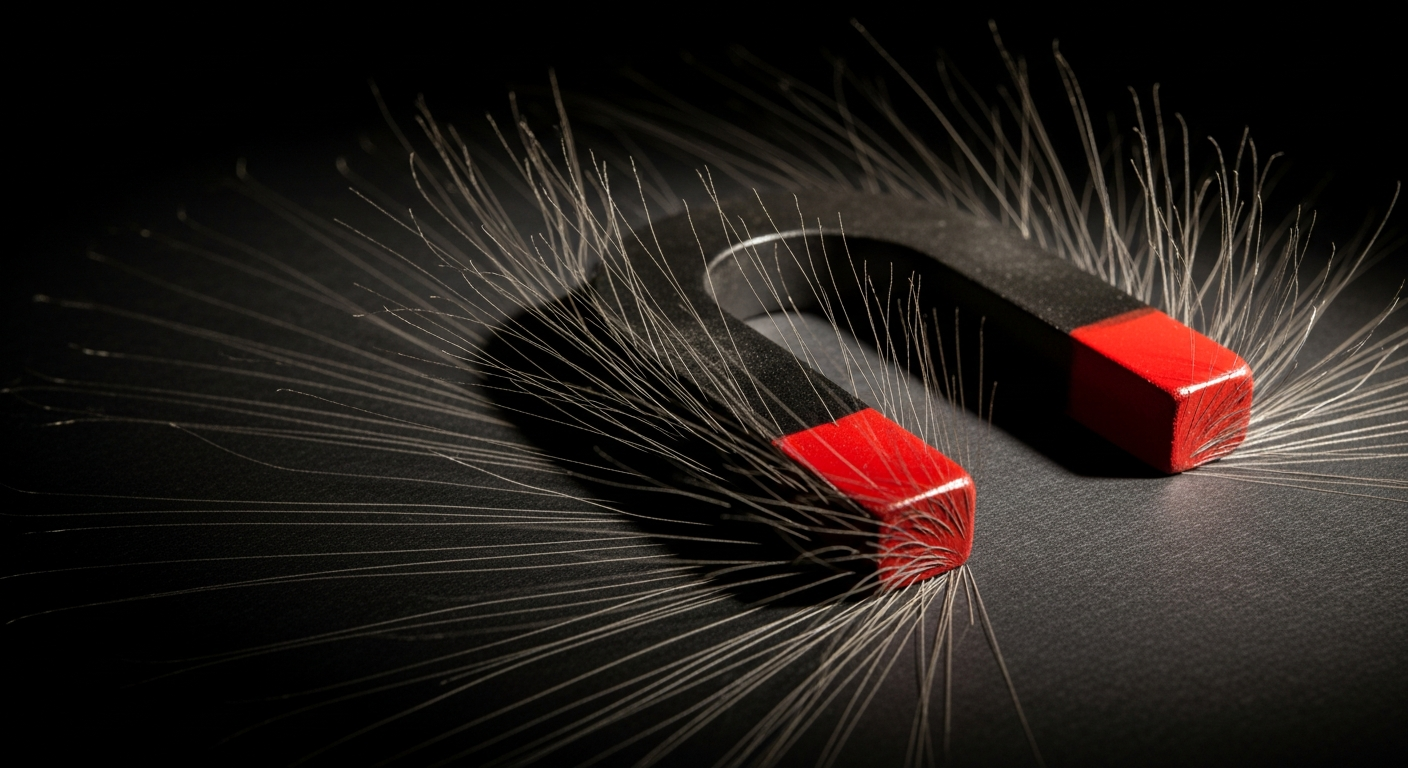
The Invisible Push
Hold two magnets close together and you feel it before you see anything: a push, a pull, a force reaching across empty space. That force isn't magic — it's the same electromagnetic force that holds atoms together, just organized around moving electric charge. Every magnet, from a fridge magnet to Earth's core, ultimately traces back to charges in motion, whether that's electrons orbiting and spinning within atoms or current flowing through a wire.
A stationary charge feels nothing from a magnetic field. Only a charge in motion feels a magnetic force — and that force always points perpendicular to both the charge's velocity and the field itself. This is the strangest and most important fact in this lesson: a magnetic field never speeds a charge up or slows it down. It only steers it, bending its path.
Finding the direction: your right hand knows
Point the fingers of your right hand along the velocity \(v\) (or the current \(I\)), then curl them toward \(B\); your thumb points along the resulting force for a positive charge or conventional current. Flip the direction for a negative charge, like an electron. This right-hand rule is the fastest way to check direction without memorizing a formula for every case.
- Identify the givens: \(q = 1.6\times10^{-19}\,C\), \(v = 3.0\times10^5\,m/s\), \(B = 0.80\,T\), and \(\theta = 90^\circ\) so \(\sin\theta = 1\).
- Apply \(F = qvB\sin\theta = (1.6\times10^{-19})(3.0\times10^5)(0.80)\).
- Multiply step by step: \((3.0\times10^5)(0.80) = 2.4\times10^5\), then \((1.6\times10^{-19})(2.4\times10^5) = 3.84\times10^{-14}\,N\).
- When the coil's plane is parallel to B, the angle between the loop's normal and B is 90°, so \(\sin\theta = 1\) — this is where torque is largest.
- Apply \(\tau = NIAB\sin\theta = (50)(2.0)(0.020)(0.30)(1)\).
- Multiply step by step: \(50\times2.0 = 100\); \(100\times0.020 = 2.0\); \(2.0\times0.30 = 0.60\).
It's tempting to picture a magnetic force pulling a charge straight toward a pole, the way gravity pulls you down. It doesn't. Magnetic force is always perpendicular to the charge's velocity, which is why a charged particle in a uniform field moves in a circle (or a helix) instead of heading straight toward the source. Also remember: \(F = qvB\sin\theta\) needs the velocity component perpendicular to B — a charge moving exactly parallel to the field feels zero magnetic force.
Check your understanding
- Magnetic force acts only on moving charges and is always perpendicular to velocity, so it changes direction, never speed.
- For a single charge, F = qvB sin θ; for a current-carrying wire, F = BIL sin θ.
- The right-hand rule gives the force direction from the velocity (or current) and the field.
- The motor principle: forces on the sides of a current loop create a torque, τ = NIAB sin θ, that spins the coil — the basis of every electric motor.
🎓 Go deeper: external courses & trusted references
External sites are listed for reference only. This course is independent and has no affiliation with, or endorsement from, the institutions named.