
Orbital Motion & Kepler’s Laws
Every orbit is just falling forever — moving sideways fast enough to keep missing the ground.
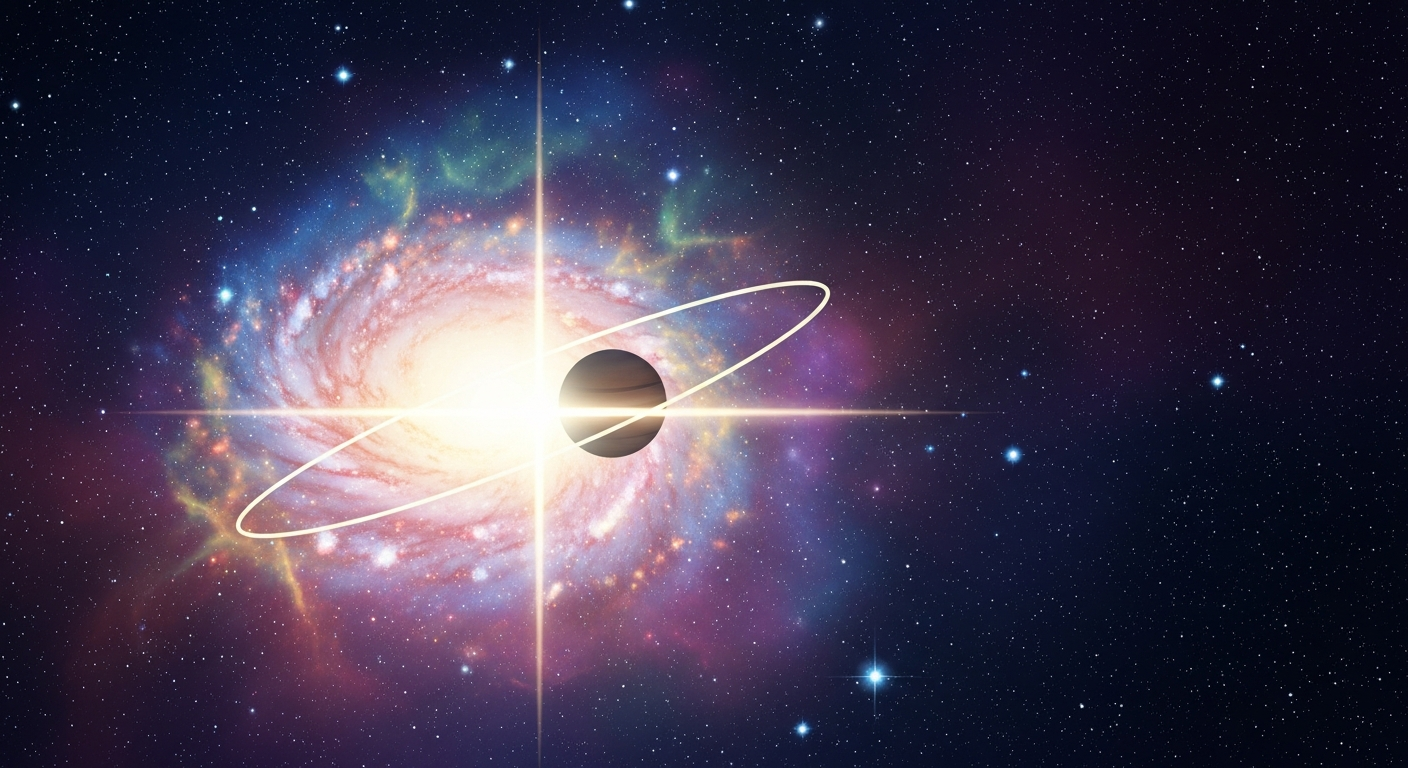
Falling Forever
Picture Isaac Newton's thought experiment: fire a cannonball horizontally from a very tall mountain. Fire it gently, and gravity curves its path down to the ground nearby. Fire it harder, and it lands farther away. Fire it fast enough, and something wonderful happens — the ground curves away from the cannonball exactly as fast as the ball falls toward it. It never lands. That is an orbit.
The International Space Station, the Moon, and every planet around the Sun are all doing the same thing: falling continuously, but moving sideways fast enough that they keep missing whatever they're falling toward.
An orbit isn't something held up against gravity — it's a state of constant free-fall. Gravity supplies exactly the sideways-pulling (centripetal) force needed to bend a straight-line path into a closed loop. No orbit needs an engine to keep going; an engine is only needed to get into that state, or to change it.
Why Ellipses, Not Circles
A perfect circular orbit is possible, but it's a special case — one exact speed at one exact radius. Give a body slightly more or less than that speed and gravity still holds onto it, but now the path stretches into an ellipse: the body swings in closer at one point (perihelion) and farther out at another (aphelion), trading speed for distance the whole way around.
This is Kepler's first law: every orbit is an ellipse with the central body sitting at one focus, not the center. Kepler's second law describes the trade-off precisely — a line from the Sun to the planet sweeps out equal areas in equal times, so the planet moves fastest when closest (perihelion) and slowest when farthest (aphelion). Nothing pushes it faster; it's the same conservation of angular momentum that speeds up a spinning skater when she pulls her arms in.
- Start from Kepler's third law solved for r: \(r^3 = \dfrac{GM\,T^2}{4\pi^2}\).
- Plug in \(T = 86{,}400\ \text{s}\), so \(T^2 \approx 7.465\times10^{9}\ \text{s}^2\).
- \(r^3 = \dfrac{(3.986\times10^{14})(7.465\times10^{9})}{4\pi^2} \approx 7.54\times10^{22}\ \text{m}^3\).
- Taking the cube root: \(r \approx 4.22\times10^{7}\ \text{m} = 42{,}200\ \text{km}\).
- Altitude above the surface: \(42{,}200 - 6{,}371 \approx 35{,}800\ \text{km}\).
- Apply the simplified law: \(T^2 = a^3 = 4^3 = 64\).
- Solve for T: \(T = \sqrt{64} = 8\).
It's tempting to think a satellite "escapes gravity" once it's in orbit — it hasn't. Gravity at the International Space Station's altitude is only about 10% weaker than at Earth's surface; astronauts float because they and their station are falling together, not because gravity switched off. The other common slip: assuming faster orbits are farther out. It's the opposite — the closer an orbit, the faster the object must move to keep from falling in, which is why the Moon creeps along on a month-long orbit while the ISS circles Earth in about 90 minutes.
Check your understanding
- Orbits are continuous free-fall: gravity supplies the exact sideways pull needed to curve a path into a closed loop.
- Kepler's three laws describe the shape (ellipse, one focus), the pacing (equal areas, fastest at perihelion), and the scaling (T² ∝ a³) of every orbit.
- Orbital speed \(v=\sqrt{GM/r}\) and period both depend only on the central mass and orbital radius, not on the orbiting object's own mass.
- Closer orbits are faster, not slower — the Moon takes weeks to circle Earth while the ISS takes about 90 minutes.
🎓 Go deeper: external courses & trusted references
External sites are listed for reference only. This course is independent and has no affiliation with, or endorsement from, the institutions named.