
The Expanding Universe
Every galaxy in the night sky is fleeing from us — and the pattern in that flight reveals the universe's birth, size, and age.
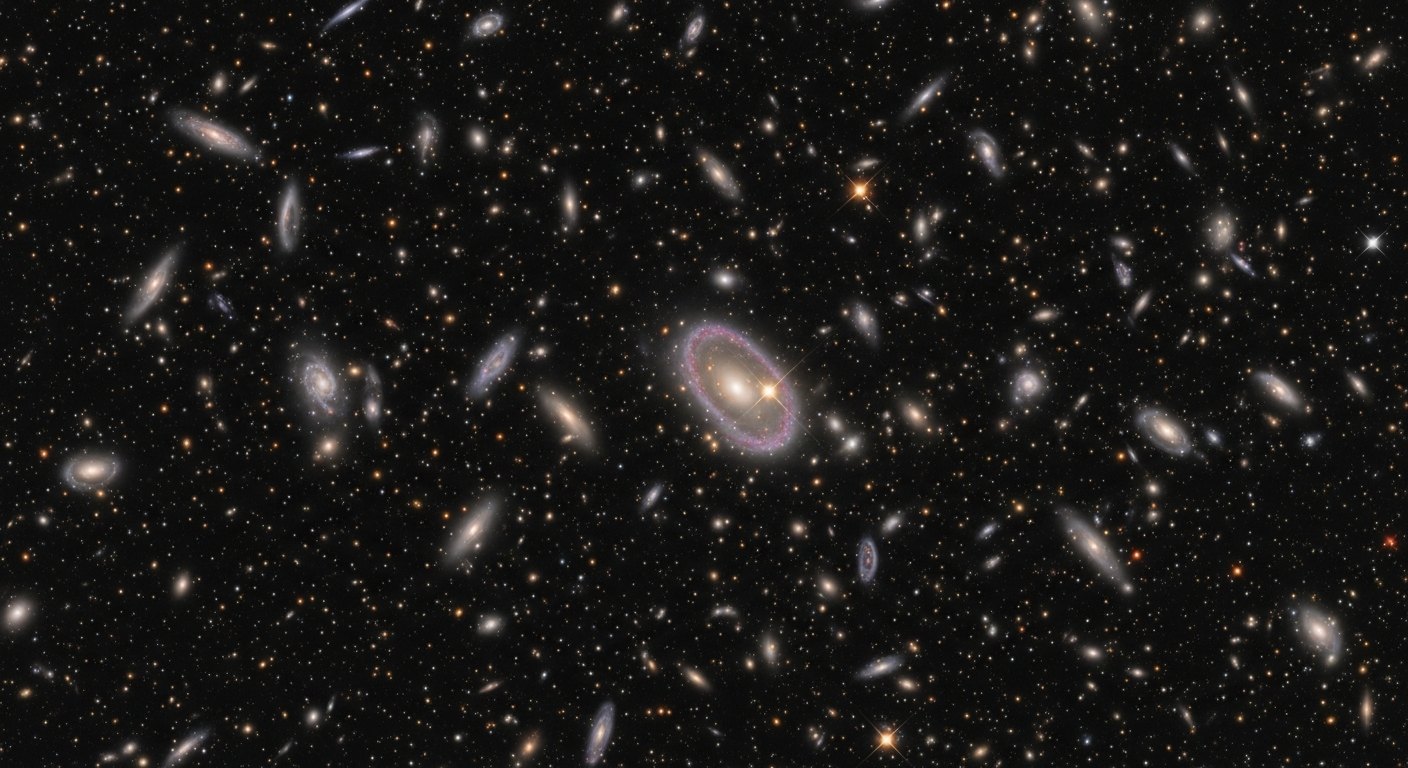
Every Galaxy Is Running Away From Us
In 1929, astronomer Edwin Hubble compared two things for a set of distant galaxies: how far away each one was, and how fast its light suggested it was moving. Almost every galaxy he checked was moving away from us — and that was strange enough on its own. But the deeper pattern was even stranger: the farther a galaxy sat, the faster it appeared to recede. A galaxy twice as distant was moving away roughly twice as fast. That simple, repeatable relationship turned out to be one of the most important discoveries in the history of science.
Hubble's observation is now a law: recession velocity is proportional to distance. This isn't galaxies flying like cannonballs through empty, unchanging space. It's space itself stretching — and every galaxy is carried along for the ride, the way two dots drawn on a balloon drift apart as you inflate it. Nothing is moving through space in the usual sense; the space between things is growing.
What Redshift Actually Measures
You've heard how an ambulance siren drops in pitch as it speeds away — the sound waves get stretched out behind it. Light does something similar. When a galaxy recedes, the wavelengths of light it emits get stretched longer as they travel to us, shifting toward the red end of the spectrum. Astronomers spot this by comparing where a familiar spectral line (say, a specific hydrogen line) should sit in the lab versus where it actually shows up in a galaxy's spectrum.
At the cosmic scale, it isn't quite the ordinary Doppler effect of something moving through space — it's the stretching of space itself carrying the light's wavelength along with it. But for nearby galaxies, the math works out the same way, which makes it a useful and intuitive first approximation.
Winding the Clock Backward: The Big Bang
If every galaxy is moving apart from every other galaxy today, then rewinding the film means everything was closer together in the past — and closer still before that. Run it all the way back, and matter, energy, space, and time appear to converge toward an extremely hot, dense state roughly 13.8 billion years ago. That beginning is what we call the Big Bang: not an explosion happening at one point within space, but the start of space and time expanding everywhere at once.
The scale involved is hard to picture: due to that ongoing expansion, the region of universe we can observe today spans roughly 93 billion light-years across, even though light has only had 13.8 billion years to travel — space itself stretched out while the light was in transit.
- Start with Hubble's law: \( v = H_0 d \)
- Substitute the values: \( v = (70 \text{ km/s/Mpc}) \times (100 \text{ Mpc}) \)
- The Mpc units cancel, leaving: \( v = 7000 \) km/s
- Find the wavelength shift: \( \Delta\lambda = 661.2 - 656.3 = 4.9 \) nm
- Calculate the redshift: \( z = \dfrac{\Delta\lambda}{\lambda} = \dfrac{4.9}{656.3} \approx 0.00747 \)
- Since \(z\) is small, estimate velocity with \( v \approx cz \): \( v \approx (3\times10^5 \text{ km/s})(0.00747) \approx 2240 \) km/s
- Use Hubble's law to solve for distance: \( d = \dfrac{v}{H_0} = \dfrac{2240}{70} \approx 32 \) Mpc
Trap 1: Cosmological redshift isn't quite the same as an object physically speeding away through fixed space — it's the stretching of space itself carrying the light along with it. The \(v \approx cz\) shortcut is a good approximation for nearby galaxies, but it breaks down at very large distances and redshifts, where the full picture needs general relativity.
Trap 2: It's tempting to think Earth sits at the center of the expansion, since everything seems to move away from us specifically. It doesn't. Expansion happens everywhere at once — an observer in any other galaxy would see exactly the same pattern, with every other galaxy receding from them. There is no center.
Check your understanding
- Hubble's Law (v = H₀d) says recession velocity grows linearly with distance, with H₀ ≈ 70 km/s per megaparsec.
- Redshift (z = Δλ/λ ≈ v/c) is how astronomers measure recession: a galaxy's light stretches toward longer wavelengths as the space it travels through expands.
- Running the expansion backward in time points to a hot, dense beginning — the Big Bang — roughly 13.8 billion years ago; 1/H₀ gives a rough, matching age estimate.
- Expansion has no center: every location in the universe would see the same pattern of galaxies receding, because space itself is stretching everywhere at once.
🎓 Go deeper: external courses & trusted references
External sites are listed for reference only. This course is independent and has no affiliation with, or endorsement from, the institutions named.