
Following Distance & the 3-Second Rule

The gap you leave in front of your car is the single easiest thing you control to avoid a rear-end crash. One simple count gives you a distance that scales automatically with your speed.
Learner's permitAll U.S. states
โฑ๏ธ About 12 min

Rear-end collisions are among the most common โ€” and most preventable โ€” crashes on the road. Almost all of them share one cause: the driver in back didn't leave enough space to react and stop before hitting the car in front. There's a simple, speed-proof way to check your gap without doing any math while you drive.

๐Ÿ’ก
The big idea: The 3-second rule gives you a following distance that automatically scales with your speed: pick a fixed point the car ahead passes, then count โ€” if you reach that same point before you finish counting three seconds, you're following too closely. It's a starting guideline, not a hard ceiling โ€” increase the count whenever conditions, your vehicle, or another driver's behavior call for more room.
๐ŸŽฏ By the end, you'll be able to
  • Perform the 3-second count to judge following distance without a speedometer or ruler
  • Explain why counting seconds works at any speed while a fixed car-length count does not
  • List at least three situations that call for increasing the count beyond 3 seconds
  • Describe the correct response to being tailgated โ€” without brake-checking
๐Ÿ“Ž Helpful to know first

Why "car lengths" doesn't work

Older advice told drivers to leave "one car length for every 10 mph." It's well-meaning, but almost nobody can judge a moving car length accurately from the driver's seat, and the math changes every time your speed does. The modern standard replaces distance with time, because time-based following distance scales itself: the faster you go, the more physical space the same time-gap buys you.

The 3-second count

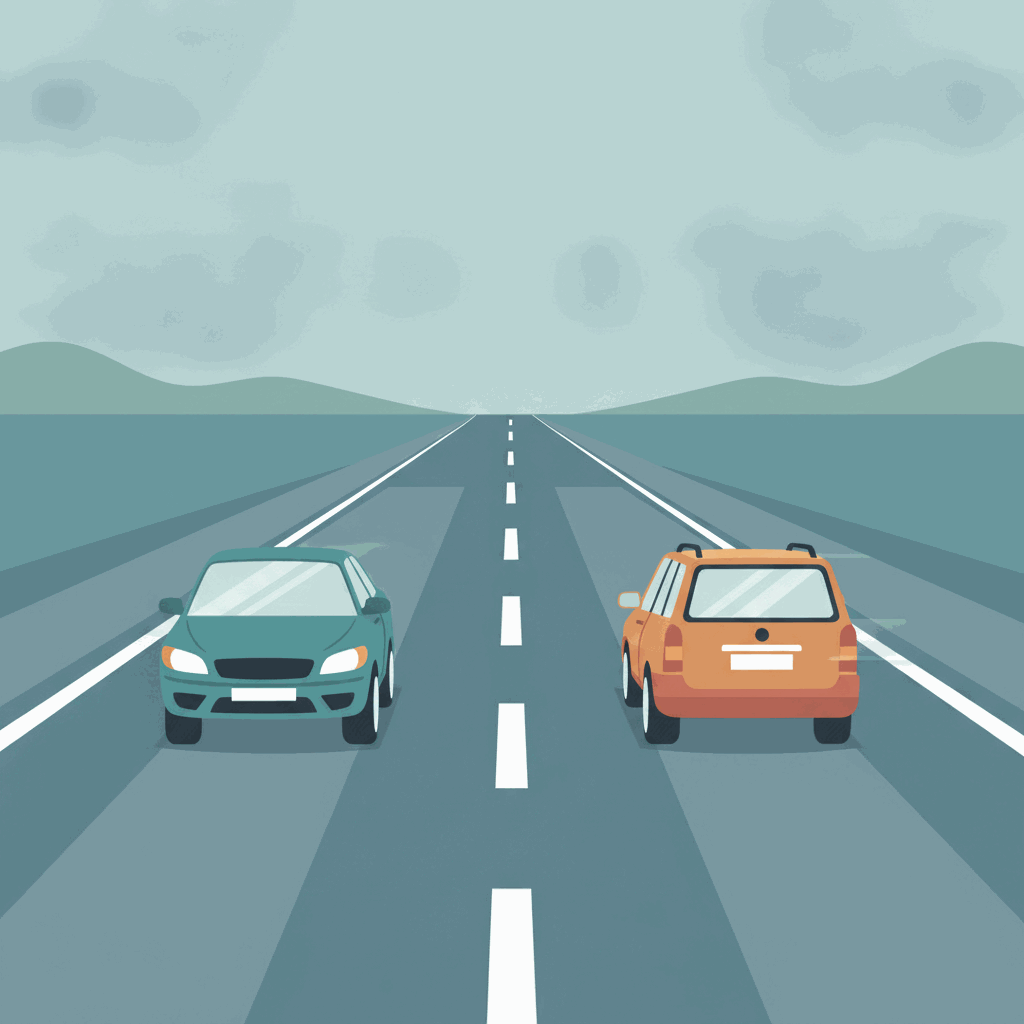
Here's the method: pick a fixed point ahead โ€” a sign, an overpass shadow, a pavement mark โ€” that the car in front of you passes. The instant its bumper passes that point, start counting: "one-one-thousand, two-one-thousand, three-one-thousand." If your own bumper reaches that same point before you finish counting, you're following too closely and should ease back.

Because it's measured in time rather than distance, the same 3-second count gives you a small physical gap at 25 mph and a much larger one at 65 mph โ€” exactly the extra room you need, since higher speed also means a longer stopping distance (more on that in the next lesson).

๐ŸŽฎ Interactive: Following & Stopping Distance LIVE
Predict first: Predict first โ€” at 65 mph, does your estimated stopping distance fit inside a 3-second gap, or spill past it?

An interactive following-distance visualizer: a speed slider from 20 to 80 mph and a road-condition toggle (dry, wet, ice) update the 3-second gap, the perception-reaction distance, the braking distance, and the total stopping distance, with a warning when stopping distance exceeds the gap.

Drag the speed slider and switch conditions. Watch how the 3-second gap and your estimated stopping distance both grow โ€” but not always at the same rate. Press "Simulate braking" to see it play out.
๐Ÿ”‘ When to add more than 3 seconds

Treat 3 seconds as the starting point on a dry road in normal conditions, not the maximum you'd ever use. Increase your count when:

  • Poor conditions โ€” rain, snow, ice, fog, or low sun glare all increase how far it takes to stop.
  • Following a large vehicle โ€” trucks and buses block your view of the road ahead, so a bigger gap buys you time to see a hazard sooner.
  • Being tailgated โ€” increasing your own following distance ahead gives you more room to slow gradually instead of braking hard, reducing the chance the tailgater hits you.
  • Riding a motorcycle, towing, or carrying a heavy load โ€” all of these change how quickly your vehicle can stop.
โš ๏ธ If someone is tailgating you
Resist the urge to brake-check (tapping the brakes to "teach a lesson"). It can cause the very collision you're trying to prevent. Instead, increase your own following distance ahead, avoid sudden moves, and when it's safe, let the tailgater pass or move over.

The 3-second rule is guidance, not a legal number

The 3-second count is a widely taught, practical guideline for judging a safe gap โ€” it is not itself a fixed number written into every state's law. What state codes generally require is following at a distance that is "reasonable and prudent," considering speed, traffic, and road conditions; the 3-second count is a simple way to put that judgment into practice.

๐Ÿ—บ๏ธ Following-distance statutes vary by state
Some states' vehicle codes add specifics on top of the general "reasonable and prudent" standard โ€” for example, minimum distances for larger trucks following each other on the highway. Check your state's DMV handbook for any specific following-distance numbers that apply to your situation.

Check your understanding

1. To use the 3-second rule, you should:
Time-based counting from a fixed point automatically scales with your speed, unlike counting car lengths, which is hard to judge accurately and doesn't adjust for speed on its own.
2. Which situation should make you increase your following distance beyond 3 seconds?
A large vehicle ahead blocks your view of hazards further down the road, so a bigger gap gives you more time to see and react to something the truck's driver already sees.
3. If another driver is tailgating you, the safest response is to:
Brake-checking can trigger the crash you're trying to avoid. Opening space ahead of you lets you slow gradually, and letting a tailgater pass removes the pressure safely.
4. Why does a time-based gap like the 3-second rule work better than a fixed number of car lengths?
Because the count is in time, not distance, the same 3 seconds converts to a larger physical gap at higher speeds โ€” exactly matching the longer stopping distance you need at speed.
โœ… Key takeaways
  • The 3-second rule: pick a fixed point, count from when the car ahead passes it to when you do โ€” 3 seconds or more is the guideline.
  • Time-based following distance scales automatically with speed, unlike counting car lengths.
  • Add seconds for poor weather, low visibility, following large vehicles, towing, or being tailgated.
  • If tailgated, don't brake-check โ€” increase your own gap ahead and let the tailgater pass when safe.
โžก๏ธ The 3-second rule works because it accounts for something every driver underestimates: how fast total stopping distance grows once you factor in reaction time and braking. Let's break that down next.

Frequently asked questions

What is the 3-second rule for following distance?
Pick a fixed point on the road that the car ahead of you passes, then count "one-one-thousand, two-one-thousand, three-one-thousand." If you reach that same point before finishing the count, you're following too closely and should drop back.
Should I increase my following distance in the rain?
Yes. Wet roads reduce tire grip and increase braking distance, so most defensive-driving guidance recommends adding extra seconds to your following gap in rain, and even more in snow, ice, or fog.
Is 3 seconds a legal requirement in every state?
The 3-second count is a widely taught practical guideline, not a single number written into every law. State codes generally require a "reasonable and prudent" following distance for the conditions; check your state's handbook for any added specifics.
Ready to check how you'd do?

You've learned the material free. Put it to the test with our practice exam โ€” hundreds of exam-style questions with instant explanations, in a realistic format.

Try the US Driving Practice Exam โ†’

Independent educational content โ€” not affiliated with, endorsed by, or connected to any state DMV, the AAMVA, or any government agency. This is study material, not legal advice; always confirm current rules with your state's official driver handbook.