
Right-of-Way: The Golden Rule
Almost every right-of-way question on the test comes down to one idea most new drivers get backwards: the right-of-way is never yours to take. It is only ever given by you, to someone else.

Ask a new driver who has the right-of-way at a confusing intersection and you'll often hear something like “I got there first” or “I was already turning.” Neither of those is how the law actually works. No law ever hands you the right-of-way outright — it only ever tells you when you must yield it to someone else. Flip that switch in your head and the rest of this module gets a lot easier.
You can't take the right-of-way — you can only give it
Nearly every state's driving law is written the same way on this point: it almost never says “Driver A has the right-of-way.” Instead it says things like “the driver on the left shall yield to the driver on the right,” or “a driver turning left shall yield to oncoming traffic.” The law only ever assigns the duty to yield — never a right to charge ahead.
That distinction matters because it flips the test-taking mindset. Instead of asking “do I have the right-of-way?”, ask the more useful question: “does the law require me to yield here?” If the answer is no, you may proceed — carefully. If the answer is yes, you wait, no matter how badly you want to go first.
Every intersection in the country is decided by the same three layers, checked in this order:
- Signals and signs first. A working traffic light, stop sign, or officer's direction always overrides the general rules below.
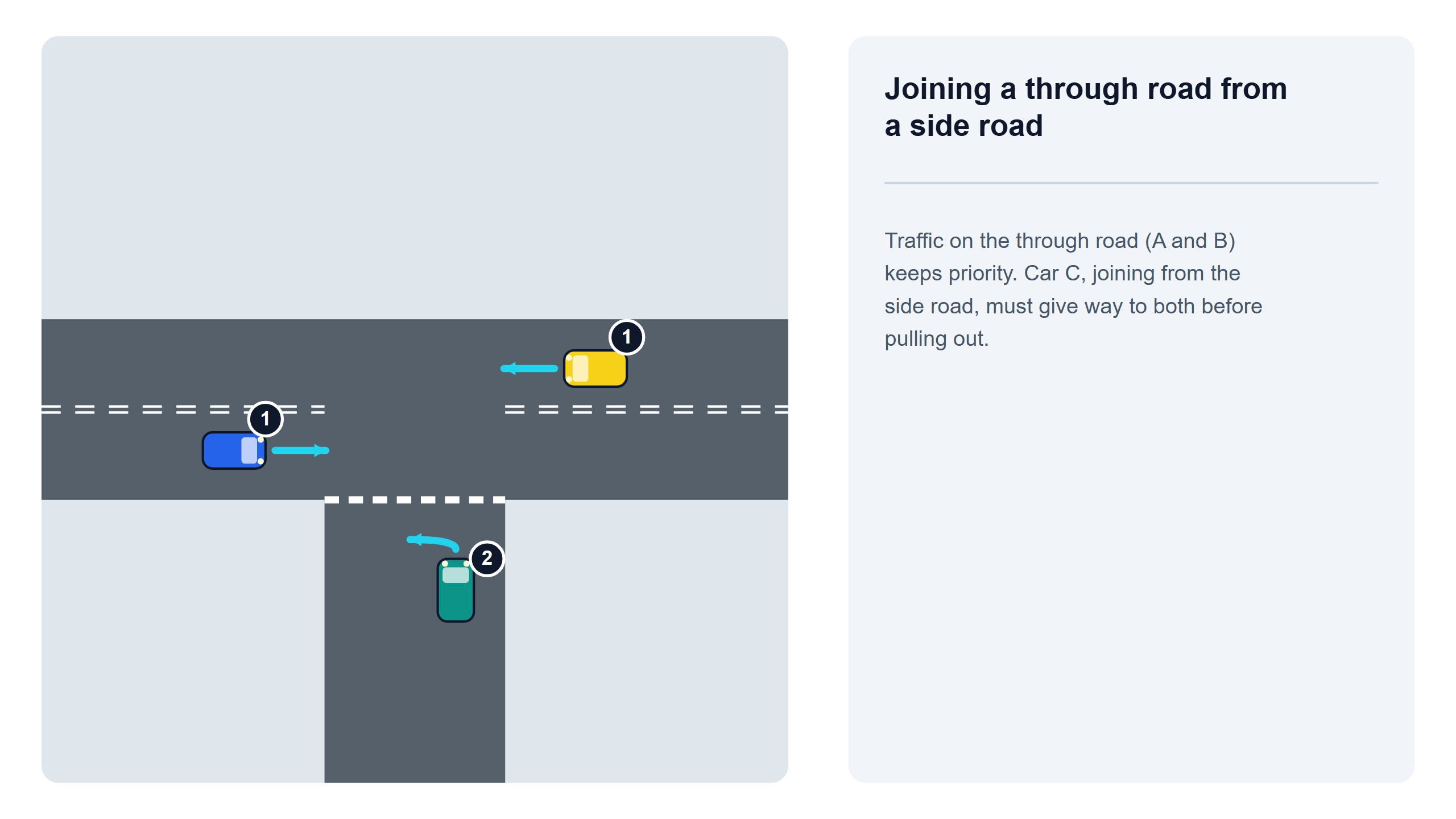
- Right-of-way rules second. If there's no signal, or it's not working, the situational rules take over — first-to-stop, yield to the right, yield to the through road, yield on entry to a circle, and so on. (Each gets its own lesson in this module.)
- Basic caution always. Even when the rules say you may go, you still have to avoid a collision. Legal right-of-way is never a reason to drive into another vehicle or a pedestrian.
Two situations where the answer is (almost) always the same
Two right-of-way calls come up so often, and matter so much, that it's worth memorizing them before anything else:
- A pedestrian in a crosswalk — marked or unmarked — has the right-of-way over a vehicle nearly everywhere in the country. You'll get a full lesson on this later in the module.
- A vehicle already inside an intersection almost always keeps the right-of-way over one that is only just arriving, no matter which direction either is coming from.
Everything else in this module — 4-way stops, uncontrolled intersections, roundabouts, left turns, turn-on-red, railroad crossings, and emergency vehicles — is really just this same “who must yield?” question applied to one more situation.
Check your understanding
- The law only ever assigns a duty to yield — it never hands you a right to go first.
- Priority order: working signals/signs first, then situational right-of-way rules, then basic caution.
- A pedestrian in a crosswalk, and a vehicle already inside an intersection, almost always keep the right-of-way.
- Legally having the right-of-way never removes your duty to avoid a crash.
Frequently asked questions
What does “right-of-way” actually mean in driving?
Does having the right-of-way mean I can't be blamed for a crash?
Who has the right-of-way if there's no sign, signal, or rule that clearly applies?
Put what you've learned to the test with our practice exam — hundreds of exam-style questions with instant explanations, in a realistic format.
Try the US Driving Practice Exam →Independent educational content — not affiliated with, endorsed by, or connected to any state DMV, the AAMVA, or any government agency. This is study material, not legal advice; always confirm current rules with your state's official driver handbook.