
Limiting Reactant & Percent Yield
Which ingredient runs out first decides how much you can make — and reality rarely gives you the full amount.
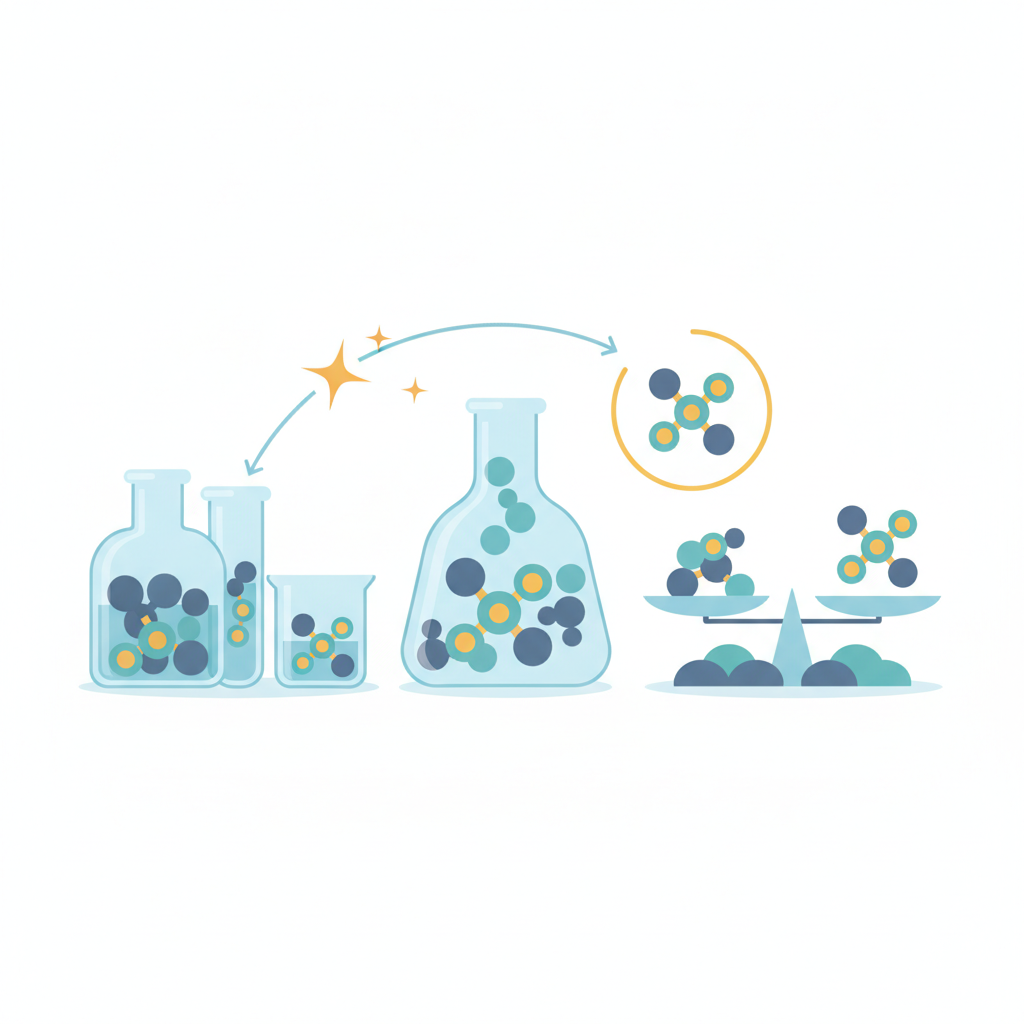
You want to make sandwiches, each needing 2 slices of bread and 1 slice of cheese. With 10 slices of bread but only 3 of cheese, you can make 3 sandwiches — then you're out of cheese, with bread to spare. Reactions work exactly like this: whichever ingredient runs out first caps the product.
The mole ratio is the recipe
A balanced equation is a recipe written in moles. For N₂ + 3H₂ → 2NH₃, the coefficients say: every 1 mole of N₂ needs 3 moles of H₂ and yields 2 moles of NH₃. Those ratios — 1 : 3 : 2 — are the mole ratios, and every reaction calculation runs on them.
When you mix reactants, they'll almost never be in the exact ratio the recipe wants. One will run out while some of the other is still left over. The one that runs out is the limiting reactant; it decides how much product you can make. The leftover one is in excess.
- The recipe needs H₂ and N₂ in a 3 : 1 ratio. For 1.0 mol N₂ you need 3 × 1.0 = 3.0 mol H₂.
- You have 6.0 mol H₂ — more than the 3.0 mol required. So H₂ is in excess and N₂ is the limiting reactant.
- Base the product on the limiting reactant: 1 mol N₂ → 2 mol NH₃, so 1.0 mol N₂ → 2.0 mol NH₃.
- The extra 3.0 mol H₂ (6.0 supplied − 3.0 used) is left over, unreacted.
Theoretical yield vs what you actually get
The amount of product the limiting reactant could make, if everything went perfectly, is the theoretical yield. In the real world you always get less — some product is lost in transfers, side reactions eat reactant, or the reaction doesn't fully finish. What you actually collect is the actual yield.
The percent yield tells you how efficient the reaction was: actual divided by theoretical, times 100.
- Check each reactant against the 2 : 1 ratio. The 3.0 mol H₂ needs 3.0 ÷ 2 = 1.5 mol O₂; you have 2.0 mol O₂, so O₂ is in excess.
- That makes H₂ the limiting reactant — even though 3.0 mol H₂ is a larger number than 2.0 mol O₂. (This is the 'smallest amount' trap in action.)
- H₂ and H₂O are in a 2 : 2 (= 1 : 1) ratio, so 3.0 mol H₂ → 3.0 mol H₂O. (Using O₂ instead would wrongly predict 4.0 mol, but there isn't enough H₂ for that.)
- Use % yield = (actual ÷ theoretical) × 100.
- = (20.0 g ÷ 25.0 g) × 100.
- = 0.800 × 100 = 80.0%.
Check your understanding
- A balanced equation gives mole ratios — the recipe every reaction calculation runs on.
- The limiting reactant runs out first and sets the maximum product.
- Find it with the mole ratio, not by picking the smallest amount — a larger amount can still run out first.
- Theoretical yield = the most the limiting reactant could make; actual yield = what you collect.
- Percent yield = (actual ÷ theoretical) × 100, usually below 100% in practice.
🎓 Go deeper: external courses & trusted references
External sites are listed for reference only. This course is independent and has no affiliation with, or endorsement from, the institutions named.