
Inside the Atom: Protons, Neutrons & Electrons

Everything around you is built from three particles. Meet them — and learn to read any atom at a glance.
High schoolIntro Gen ChemUni Year 1
⏱️ About 18 min
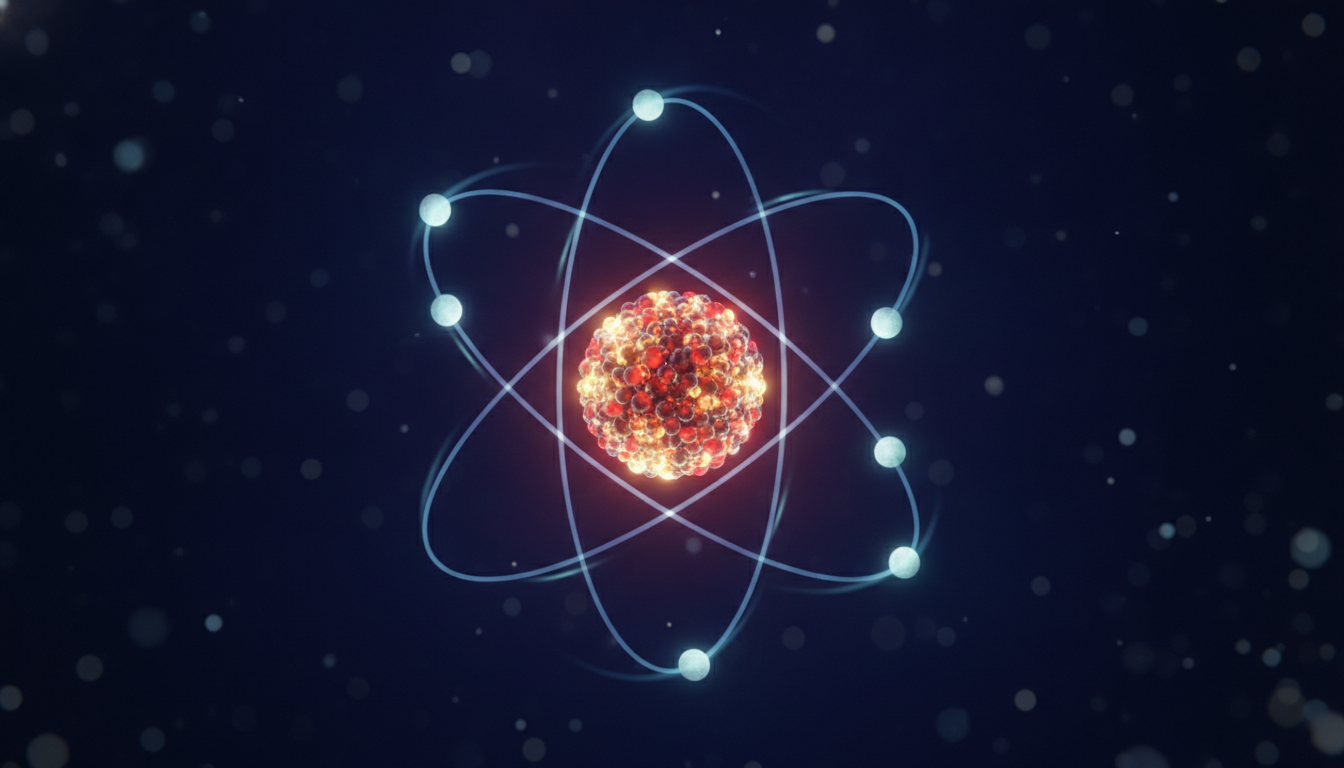
Inside the Atom: Protons, Neutrons & Electrons — illustration
Illustration only — the labelled, count-accurate diagrams below are generated from each atom's real proton, neutron and electron numbers.

Hold out your hand. It — and this screen, the air, the whole world — is built from just three kinds of particle, arranged in different numbers. Learn those three, and the entire periodic table stops being a wall of symbols and starts being a story you can read.

💡
The big idea: An atom is a tiny, dense nucleus of protons and neutrons, surrounded by fast-moving electrons. The number of protons alone decides which element you have — change it and you change the substance itself.
🎯 By the end, you'll be able to
  • Name the three subatomic particles and their charge, mass, and location
  • Use the atomic number (Z) to identify an element and its electron count
  • Use the mass number (A) to find the number of neutrons (A − Z)
  • Read an atom's shell arrangement from a count-accurate Bohr diagram
📎 Helpful to know first
  • What matter is (solids, liquids, gases)
  • Scientific notation (helpful, not required)

Three particles build everything

Zoom in on any material far enough and you reach atoms — the smallest unit of an element that still behaves like that element. Every atom is assembled from three subatomic particles:

  • Protons — positive charge (+1), found in the nucleus. Their number is the identity of the element.
  • Neutrons — no charge, also in the nucleus. They add mass and stability but don't change which element it is.
  • Electrons — negative charge (−1), moving in the space around the nucleus. Almost massless, but they do all the chemistry.

The nucleus is astonishingly small and dense: if an atom were a sports stadium, the nucleus would be a marble at the centre and the electrons a faint blur in the stands. Matter is mostly empty space.

🔑 The one number that names the element
The atomic number (Z) is the number of protons. Every carbon atom has 6 protons; every oxygen atom has 8. Add one proton to carbon and it is no longer carbon — it's nitrogen. Protons are the element's fingerprint.
e⁻ e⁻ n=1 (2 e⁻) e⁻ n=2 (1 e⁻) 3 p⁺ 4 n Lithium · Li · Z=3 · mass number 7

Bohr model of lithium: a nucleus of 3 protons and 4 neutrons, surrounded by an inner shell of 2 electrons and an outer shell of 1 electron.

A lithium atom, drawn from its real numbers: 3 protons and 4 neutrons in the nucleus, with electrons filling shells 2 then 1. This figure is generated from Z = 3 and mass number 7 — the counts cannot be wrong.

Neutral atoms balance their charges

In a neutral atom the positive and negative charges cancel exactly, so the number of electrons equals the number of protons. Lithium (Z = 3) has 3 protons and 3 electrons. If an atom gains or loses electrons it becomes a charged ion — but the proton count never changes for a given element.

\[ \text{neutrons} = A - Z \]
Mass number A counts protons + neutrons, so neutrons = A − Z. For lithium-7: 7 − 3 = 4 neutrons.
✨ Atomic number vs mass number
Z (atomic number) = protons — defines the element. A (mass number) = protons + neutrons — defines the specific isotope. Two atoms of the same element always share Z but can differ in A (that's the next lesson: isotopes).
🎮 Interactive: Atom Builder LIVE
Predict first: Before you touch it — predict: if you add one proton to a lithium atom, what element do you get?

An interactive atom builder: add or remove protons, neutrons and electrons with buttons and watch the element name, charge, and Bohr diagram update live.

Add and remove protons, neutrons and electrons. Watch the element name, the charge, and the shell diagram update instantly. Notice: change the proton count and the element itself changes; change electrons and you make an ion; change neutrons and you make an isotope.
📝 Worked example: An atom has 8 protons, 8 neutrons, and 8 electrons. What is it, and what is its charge?
  1. Protons = 8, so the atomic number Z = 8. Element 8 is oxygen.
  2. Electrons (8) = protons (8), so the charges balance — the atom is neutral.
  3. Mass number A = protons + neutrons = 8 + 8 = 16, so this is oxygen-16.
✓ A neutral oxygen-16 atom (¹⁶O).
✏️ Practice: A neutral atom of aluminium has mass number A = 27. Aluminium's atomic number is Z = 13. How many neutrons does it have?
neutrons
Solution
  1. Neutrons = A − Z.
  2. = 27 − 13.
  3. = 14 neutrons. (It also has 13 protons and, being neutral, 13 electrons.)

Check your understanding

1. Which particle's count decides which element an atom is?
The number of protons (the atomic number, Z) defines the element. Neutrons change the isotope; electrons change the charge.
2. A neutral atom has 11 protons and 12 neutrons. How many electrons does it have?
Neutral means electrons = protons = 11. (The 12 neutrons set the mass number to 23, but don't affect electron count.)
3. Where is almost all of an atom's mass concentrated?
Protons and neutrons sit in the nucleus and carry ~99.9% of the mass; electrons are almost massless and the atom is mostly empty space.
✅ Key takeaways
  • Atoms are built from protons (+), neutrons (0) in a dense nucleus, and electrons (−) around it.
  • Atomic number Z = number of protons = the element's identity.
  • Mass number A = protons + neutrons, so neutrons = A − Z.
  • A neutral atom has equal protons and electrons; gaining/losing electrons makes an ion.
➡️ You can now read any atom's protons, neutrons and electrons. But if neutrons don't change the element, why do we bother counting them? Next, isotopes show why — and where the decimal atomic masses on the periodic table come from.
Want to test yourself on this? Try the Chemistry practice test →